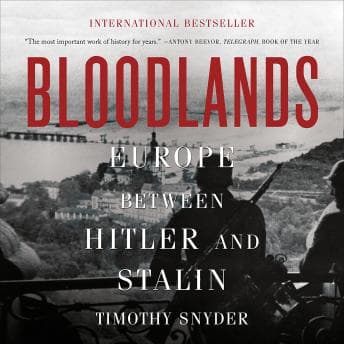

I was up at 0300 last Tuesday. Couldn't sleep — one of those nights where the brain won't shut off, old memories mixing with tomorrow's client briefing. So I put this on, thinking heavy history might actually tire me out. Instead I sat in the dark kitchen for three hours, coffee going cold, Ranger pressed against my leg like he knew something was wrong.
Something was wrong. This book is wrong — in the sense that everything it describes is so fundamentally broken about the 20th century that you come out the other side a different person.
The Body Count Nobody Taught You
Let me cut to the chase: Snyder's central argument is that we've been looking at Hitler and Stalin through separate lenses when we should be looking at the geography between them. The "bloodlands" — Poland, Ukraine, Belarus, the Baltic states — is where roughly 14 million civilians were deliberately murdered between 1933 and 1945. Not combat deaths. Not collateral damage. Deliberate, policy-driven killing.
What hit me hardest was how Snyder dismantles the comfortable narrative most Americans carry around. We think about the Holocaust as gas chambers and concentration camps. Snyder forces you to reckon with the fact that more Jews were shot in ditches than were gassed at Auschwitz. We think about Stalin's crimes as the Gulag. Snyder shows you the Ukrainian famine — the Holodomor — where Stalin starved roughly 3.3 million people to death in a single year. On purpose. As policy.
I've seen this scenario play out in real life — not at this scale, obviously, but the bureaucratic machinery of death, the way ordinary people get folded into monstrous systems. Snyder doesn't let you look away from that mechanism. He walks you through how Soviet and Nazi policies fed off each other, how Stalin's purges created the power vacuum Hitler exploited, how the Molotov-Ribbentrop Pact turned Poland into a killing field from both directions simultaneously.
The author clearly did their homework. This isn't polemic. It's meticulous, footnote-heavy history that still manages to center individual human beings. Snyder keeps pulling you back to specific people — a girl's diary entry during the siege of Leningrad, a Polish officer's last letter before Katyn. Those details are what separate this from a statistics textbook.
Cosham Carries the Weight Without Breaking
Ralph Cosham's narration is — and I mean this as high praise — invisible. His British accent gives everything a measured, almost documentary quality. No dramatic pauses where he's clearly trying to make you cry. No vocal quiver when describing a mass grave. He trusts the material, and the material is devastating enough on its own.
At 19 hours, this is a serious commitment. I listened at my usual 1.25x and it worked fine — Cosham's pacing is already brisk and controlled, so bumping it up slightly doesn't create any problems. But I'll be honest: there were stretches, particularly through the statistical analysis of famine mortality rates, where the density of information tested my attention even in the car. This isn't a complaint about the narrator. It's the nature of rigorous history. You can't make demographic data exciting, and Cosham doesn't pretend to.
What he does brilliantly is maintain the right gravity. When Snyder describes how mothers in Ukraine were arrested for cannibalism after feeding on children who had already died of starvation — Cosham delivers it straight. No maudlin overlay. Just the facts, spoken with the dignity they deserve. That restraint is exactly what this subject demands.
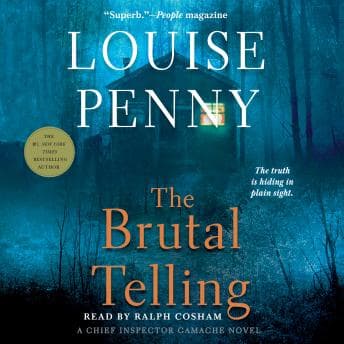
Cosham brings that same steady calm to the far gentler Brutal Telling — a welcome palate cleanser if you need one after this.Who Needs to Hear This (And Who Should Prepare Themselves)
If you're trying to understand why Ukraine matters — not just in 2014 or 2022, but going back a century — this is the book. Period. Snyder wrote it in 2010 and it reads like prophecy now. He distilled those same arguments into a much shorter, sharper book, On Tyranny, which reads like a field manual for spotting the warning signs. The patterns he identifies, the way great powers treat the nations between them as expendable, as spaces rather than places with people — I've briefed clients on geopolitical risk using frameworks that Snyder articulated years before the current crisis.
But I want to be straight with you: this is not easy listening. Content warnings exist for a reason. There are passages in here that will stay with you for weeks. If you've got any personal connection to the Holocaust, to Soviet repression, to the history of Eastern Europe — approach with care. I've been to some dark places in my career and this book still got to me.
Skip this if you want narrative history with a hero. There are no heroes here. Just victims, perpetrators, and the vast gray space between.
Mission Debrief
Worth your time? Here's the debrief: This is essential history. Not comfortable history, not inspiring history, but the kind of history that rewires how you understand the 20th century. Snyder's framework — treating the overlap zone between Hitler and Stalin as a single story — is one of those ideas that, once you hear it, you can't unhear it. Cosham delivers it with exactly the right tone. Ranger approved this one, though he looked concerned about my mood for the rest of the week.
Nineteen hours well spent. Just don't start it at three in the morning unless you're prepared to lose the whole night.