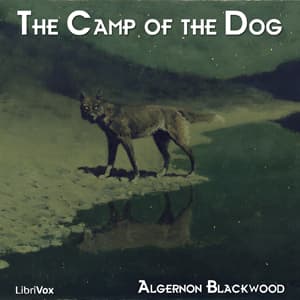

Okay, so here's the thing about Algernon Blackwood: the man understood that real horror lives in the spaces between certainty. Not in the monster itself, but in the question of whether there even is a monster. And Camp of the Dog is basically a case study in that psychological ambiguity.
I listened to this during my morning jogs through Cambridge - which, looking back, was maybe not the smartest choice. There's something deeply unsettling about running past quiet trees at 6 AM while a narrator describes something massive and wolf-like stalking campers on a Baltic island. My heart rate data that week was... interesting.
The Slow Creep of Dread
Blackwood doesn't do jump scares. He does the slow, inexorable build of wrongness. A party of friends camping on a deserted island. Something watching from the trees. A man whose behavior becomes increasingly erratic. And always, always the question: is this supernatural, or is this the human mind fracturing under isolation?
The protagonist exhibits classic symptoms of what we'd now call hypervigilance - that state where your nervous system is convinced danger is everywhere, and it starts manufacturing evidence to support that belief. I saw similar psychological fracturing play out in Their Eyes Were Watching God, where isolation and social pressure warp how characters perceive reality. Is there really a wolf? Is it something worse? Or is this a case study in collective anxiety and suggestion? Blackwood never fully commits, and that's the genius of it.
Psychologically, this tracks beautifully with what we know about group dynamics under stress. Isolation amplifies everything. One person's fear becomes everyone's fear. And when you add the possibility of the supernatural - or even just the belief in it - rational thought starts looking pretty fragile.
Charlie Blakemore's Atmospheric Delivery
Now, about the narration. Charlie Blakemore has a clear, somewhat dramatic style that works really well for Blackwood's prose. The enunciation is crisp, the pacing deliberate. He gets that this isn't a story you rush through.
That said - and I want to be honest here - some listeners find the delivery a bit monotone. I can see that. There are moments where more emotional variation might have elevated the tension. But honestly? I think the steadiness works for this particular story. Blackwood's horror is understated, almost clinical in its observation of human fear. A more theatrical reading might have tipped it into melodrama.
The atmospheric delivery is where Blakemore really shines. When the dread starts building, when the narrator is describing those long Baltic nights and the sounds from the forest - yeah, he nails that. The production is clean, no weird audio issues, which matters when you're trying to sink into a mood piece like this.
Who Should Listen (And Who Should Skip)
Look, let's be real. This is not a fast-paced thriller. If you want action and resolution, this will frustrate you - skip it. The pacing is slow. Deliberately so. Blackwood was writing in the early 1900s, and his style reflects that - more interested in mood and the uncanny than in plot mechanics. That same commitment to atmospheric dread over plot mechanics shows up in Selected Short Stories by F. Scott Fitzgerald, where the real horror is always psychological.
But if you're a fan of classic supernatural fiction? If you appreciate psychological complexity in your horror? This is a fascinating listen. The research actually shows that anticipatory fear - the dread of what might happen - is often more powerful than the event itself. Blackwood understood that instinctively.
I found myself asking: why does the protagonist really stay on that island? What keeps them there when every instinct says leave? The answer says something uncomfortable about human nature and our relationship with fear. We're drawn to the things that terrify us. (My therapist would have thoughts about this character, honestly.)
At just under three hours, it's a perfect length for this kind of atmospheric piece. Long enough to build the mood, short enough not to overstay its welcome. I listened at normal speed - this isn't one you want to rush. Let the dread accumulate.
Would I Listen Again?
Maybe not immediately. But there's something about Blackwood's work that rewards revisiting. Each time you notice new details, new psychological layers. The ambiguity that might frustrate some readers is exactly what makes it interesting to someone like me. What makes this character compelling is precisely what we can't pin down.
If you're new to Blackwood, this is a solid entry point. If you're already a fan, you know what you're getting. And if you're running through Cambridge at dawn, maybe save it for a different context. Just a thought.









