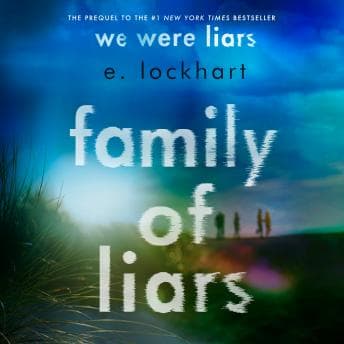

"We are the family of liars."
That line hits different at 6:14 AM when you're wedged between two sleeping strangers on the Caltrain and your coffee hasn't kicked in yet. I picked up Family of Liars because I'd burned through We Were Liars during a particularly brutal on-call weekend last year—finished it in one sitting while monitoring dashboards—and the prequel had been sitting in my queue ever since. (If you somehow missed it, We Were Liars is one of those audiobooks that rewires something in you—read that first, always.). Different generation of Sinclairs, same private island, same slow-drip poison of privilege and secrets.
The Sinclair Family: Now With More Ghosts and Fewer Reliable Narrators
So here's the thing about this book: it's basically We Were Liars but for the parents' generation, set in the 1980s and 1990s, with an unreliable narrator who knows she's unreliable and keeps telling you so. Carrie Sinclair is our guide through summers on Beechwood Island, and she's messy in ways that feel genuinely uncomfortable rather than charmingly flawed. She's got an addiction arc that doesn't pull punches, a relationship with a boy named Pfeff that's equal parts magnetic and toxic, and a family secret involving her sister's death that she keeps circling back to like a function caught in a recursive loop with no base case.
The structure is nonlinear—jumping between different summers—which is where some listeners apparently lost the thread. And I get it. Around hour three, I had to pause and mentally reconstruct the timeline because the jumps between 1987 and the early '90s can blur together, especially when you're half-conscious on public transit. But honestly? Once I mapped it in my head (engineer brain, can't help it), the way the pieces click into place is pretty satisfying. Lockhart is doing something deliberate with the fragmented chronology—you're experiencing memory the way Carrie experiences it: selective, self-serving, full of gaps she doesn't want to fill.
The paranormal element is new for this series. There are ghosts. Actual ghosts. Or maybe not—the book keeps that ambiguity alive just long enough to mess with you. It's a strange addition that works better than it should, mostly because Carrie is already so detached from reality through grief and substance abuse that the supernatural feels like an extension of her psychological state rather than a genre pivot.
Kimberly Farr Did the Heavy Lifting Here
Kimberly Farr narrates, and she's doing something subtle that I really appreciated: she reads Carrie with this detached, almost clinical tone that occasionally cracks open into raw emotion, and those cracks are where the book lives. Farr brings a similar quiet intensity to Lucy by the Sea—different genre, same surgical emotional precision. The way she delivers Carrie's recounting of her worst childhood memory—flat and controlled at first, then increasingly unsteady—felt like listening to someone actually dissociating in real time. It's the kind of performance where the restraint IS the performance.
Now, I'll be honest: she's not Ray Porter. (Nobody is. I said what I said.) But Farr handles the large cast of Sinclair women—Carrie, her sisters Bess and Liberty, their mother Tipper—with enough variation that I could track who was speaking even during my pre-coffee fog. Tipper's clipped WASP-y delivery versus Carrie's more halting, searching cadence was the key differentiator. The male characters are less distinct, but Pfeff comes through with enough sardonic energy to be recognizable.
No sound effects, no music, just clean narration. Production quality is solid—no weird volume drops or room tone shifts that plague some audiobooks.
The Sequel Problem (But Make It a Prequel)
Let me be straight: if you haven't read/listened to We Were Liars, this prequel loses about 40% of its impact. The dread works because you already know where the Sinclair family ends up. You're watching the foundations crack in real time, knowing the house eventually collapses. Without that context, it's a decent family drama with some gothic elements. With it, it's a gut punch in slow motion.
The twist—because of course there's a twist, this is a Liars book—didn't land as hard for me as the original's did. Partly because I was expecting it (the New York Times literally warns you one is coming on the back cover, which, thanks for that), and partly because Lockhart's structural clues are more visible this time. I clocked something was off around hour five, and by hour seven I'd basically reverse-engineered it. But the execution is still sharp enough that knowing didn't ruin the moment.
The ROI on this audiobook is decent but not spectacular. 8 hours 51 minutes, which I split across about four commutes at 1.5x. It's a slow burn that rewards patience, and the emotional payoff in the final two hours is strong enough to justify the sometimes meandering middle section.
Who Gets on This Train and Who Waits for the Next One
Perfect for: fans of We Were Liars who want the backstory, anyone who likes their family dramas soaked in old money guilt and gothic atmosphere. Works great on a commute—the pacing is steady enough that you won't lose the plot if someone's having a loud phone conversation next to you.
Skip for: anyone expecting a standalone (it's not), anyone who needs fast pacing (this is a 4-commute simmer, not a sprint), or anyone who found We Were Liars overhyped and is hoping the prequel converts them. It won't.
Kevin asked me what I was listening to and I said "rich people being terrible on an island" and he said "so Succession but YA?" And... yeah, kind of. That's not a bad pitch, actually.