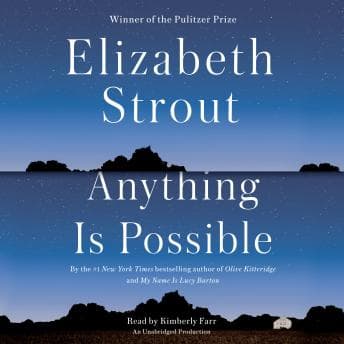

Everyone told me Elizabeth Strout was a quiet writer. Gentle. Compassionate. And she is — the way a surgeon is gentle when they're cutting you open.
I started this one during a Saturday morning walk along the lakefront with Denise. We do this thing where we share earbuds, one each, and listen together. Twenty minutes in, she pulled her earbud out, looked at me, and said, "This is going to be one of those books that makes you stare at the ceiling tonight, isn't it?" She wasn't wrong. By the time we got home, I was three stories deep into Amgash, Illinois, and I couldn't stop.
Small Towns Are Never Small
Let's talk about what Strout is really doing here. Anything Is Possible reads like a novel but breathes like a short story collection. Each chapter centers on a different resident of Amgash — connected by geography, by gossip, by the stubborn gravity that small towns exert on people who never leave and the guilt they impose on people who do. Lucy Barton, the protagonist of Strout's earlier novel, hovers over these stories like a rumor. She got out. She became a writer in New York. And the people she left behind — her siblings, her neighbors, the janitor who once saw something in her — are still here, still trying.
What struck me hardest was the story about the two sisters: one who married into money and slowly traded away pieces of herself, and the other who found something like salvation in reading. That second sister — I teach kids like her every single year. The quiet ones in the back row who aren't disengaged, they're just somewhere else entirely, living inside a paragraph. Strout gets that right in a way that made my chest hurt.
And then there's the chapter where a grown woman visits her mother, who's found happiness in a new country, a new life. The daughter wants the mother she remembers. The mother has become someone else. Strout doesn't resolve it. She just lets both of them sit with it. This is why we still read the classics — and why Strout, I'm calling it now, is writing them.
Kimberly Farr and the Art of Not Overdoing It
Here's where I came in skeptical and left converted. The research I'd seen praised Farr's performance in very general terms — "stellar," "perfect" — words that tell you nothing. So I was braced for competent but unremarkable.
What Farr actually does is something more difficult than theatrical range. She modulates. The narrator understands that pause is punctuation. In the chapter about Dottie — a character carrying decades of resentment like a bag of wet cement — Farr slows down just slightly, lets the sentences land heavier. Not dramatically. You almost don't notice it. But your body does. I caught myself gripping my pen tighter while grading sophomore essays at 11 PM, and I had to stop and ask myself why my shoulders were up around my ears.
She doesn't do wildly different voices for each character. I wish I could tell you about her vocal range, but that's not what this performance is about. It's interpretive restraint. Strout writes sentences that look simple on the page — subject, verb, object — but carry enormous emotional weight underneath, and Farr trusts those sentences. She doesn't italicize with her voice what Strout left plain on purpose. That's a choice, and it's the right one.
Who This Is For (And Who Should Walk Away)
If you want plot — actual, propulsive, what-happens-next plot — this will frustrate you. Things happen in these stories, but they happen the way things happen in life: slowly, sideways, sometimes offscreen. My students would hate this. I love it. I had a similar reaction to The Christie Affair — another book where the real story keeps slipping sideways just when you think you've got a grip on it.
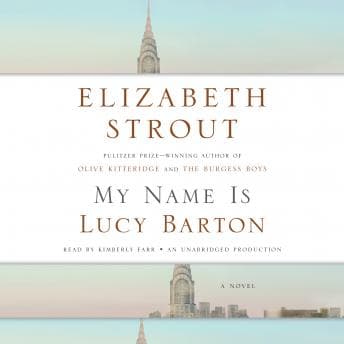
If you loved Olive Kitteridge, this is its spiritual successor. Same architecture — interconnected lives in a place most people drive through without stopping. Same willingness to sit with characters who aren't likable but are deeply, uncomfortably recognizable. If you loved My Name Is Lucy Barton, this is the mirror held up behind it, showing you everything Lucy left behind.
At eight and a half hours, it's the kind of book you can finish in a weekend, but I'd argue you shouldn't. Take it story by story. Let each one settle. The prose deserves to be savored — listen at 1.0x, fight me — because Strout builds meaning through accumulation, not speed. Each story refracts the others. By the end, Amgash feels less like a fictional town and more like a place you've been avoiding going back to.
This is not a book about whether anything is possible. It's a book about what's already happened, and whether the people it happened to can survive knowing it.
Worth Pausing the Faculty Meeting For
I'm going to be honest: I don't know if this is a book everyone needs to own. It's quiet. It's deliberately paced. It doesn't announce itself. But I've thought about it every day for a week, which is more than I can say for the last five books on my shelf. Strout writes people the way people actually are — contradictory, disappointed, occasionally brave without knowing it — and Farr reads them with exactly the right amount of nothing extra. That's performance art.
Episode 48 of The Annotated Life is going to be about this one. Mom, try to stay awake.