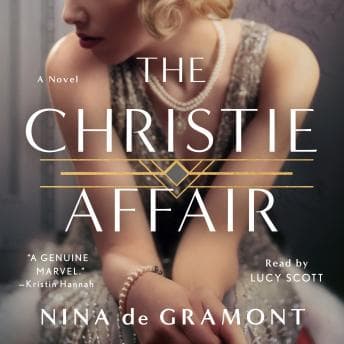

"A long time ago, in another country, I nearly killed a woman."
That opening line hit me around hour two of grading sophomore essays on The Great Gatsby—and suddenly Nick Carraway's unreliable narration felt quaint by comparison. Nina de Gramont hands us a confession in the first breath, then spends ten hours making us question everything about the confessor.
This is why we still read the classics. And why we reimagine them.
The Other Woman Gets Her Say
Here's what fascinates me about this novel: we know Agatha Christie disappeared for eleven days in 1926. The newspapers went mad. Thousands searched for her. She turned up at a spa hotel, claiming amnesia. History remembers it as a mystery.
De Gramont says: what if it wasn't a mystery at all? What if it was a reckoning?
Nan O'Dea is the mistress—the homewrecker, the villain in every telling of this story. But de Gramont refuses to let her be a footnote. She gives Nan a past that stretches back to Ireland, to the Magdalene laundries, to a loss so devastating that her affair with Archie Christie becomes not just understandable but almost inevitable. The narrative jumps between 1925 London and earlier decades, between Nan's perspective and Agatha's, between what happened and what we're told happened.
My students would hate this. I love it.
The time jumps—and there are many—demand attention. This isn't a book for half-listening while pretending to read emails from the superintendent. (Sorry, Dr. Martinez.) You need to track whose voice you're hearing, which year you're in, which version of Nan is speaking. Some listeners found this disorienting, even irritating. I found it honest. Memory doesn't work linearly. Trauma especially doesn't.
Lucy Scott Understands That Pause Is Punctuation
The narrator here carries an enormous burden. She's voicing an Irish woman performing Englishness, an American author imagining British society, and Agatha Christie herself—one of the most recognizable literary voices of the twentieth century. Lucy Scott handles this with the kind of quiet confidence that makes you forget you're listening to a performance.
Her Irish lilt for Nan's internal moments versus the clipped, careful accent Nan adopts in London society—that distinction alone tells half the story. You hear the performance within the performance. And her Agatha isn't a caricature of the mystery queen; she's wounded, intelligent, and far more perceptive than her husband realizes.
The pacing is deliberate. Scott doesn't rush the emotional beats, which some might find slow. But the prose deserves to be savored. When Nan describes the "particular feeling, the urge to murder"—that "joy" in it—Scott delivers it with a chill that made me pause my walk along the lakefront. Denise asked if I was okay. I wasn't sure.
What De Gramont Is Really Saying
This isn't a mystery novel, despite the mystery at its center. It's a novel about what we do to women—and what women do to survive. The Magdalene laundries. The polite cruelty of upper-class marriage. The way a mistress is blamed for a husband's wandering. De Gramont layers these indictments without ever becoming preachy, which is harder than it sounds.
If you loved Rebecca, this is its spiritual successor—another novel about a woman overshadowed by another woman, about marriages that imprison, about the stories we tell ourselves to justify what we've done. Paris Seamstress works similar territory—women navigating impossible choices in historical settings where their agency is constantly under threat.
The mysterious deaths at the spa that bookend the disappearance add genuine tension, but they're almost beside the point. The real mystery is simpler and darker: how does a person become capable of destroying another person's life? And can we ever really know? Midnight Library asks similar questions about the choices we make and the lives we destroy—including our own—though it takes a more fantastical route to get there.
The Iceberg Under the Water
Look, this audiobook requires commitment. Ten hours of non-linear storytelling, multiple POV shifts, and emotional weight that accumulates rather than explodes. It's not for background listening. It's not for the gym.
But if you want something that treats historical fiction as more than costume drama—if you want to think about how we remember women and how we forget them—this delivers.
Skip it if: You want a cozy mystery or a straightforward thriller. You need events in chronological order to stay engaged. You're looking for Agatha Christie fan fiction that worships at her altar.
Listen if: You've ever wondered what the "other woman" was thinking. You love unreliable narrators done right. You believe that the best historical fiction illuminates the present.
Hemingway said the dignity of movement of an iceberg is due to only one-eighth of it being above water. De Gramont shows us just enough. The rest, we feel.