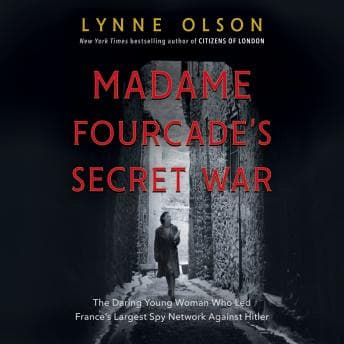
Everyone talks about the men of the French Resistance. The film versions, the novels, the History Channel specials - it's always men in berets smoking cigarettes and looking brooding. So when I tell you that the leader of France's largest spy network during WWII was a thirty-one-year-old mother of two who once escaped a Nazi jail cell by stripping naked and squeezing through the bars, you'd think I was pitching a thriller manuscript. Nope. This is biography. This actually happened.
Lynne Olson's Madame Fourcade's Secret War has been on my list forever, and I finally got to it during a stretch of nights where my unit was mercifully quiet (I knocked on every available wooden surface, trust me). Sixteen hours is a commitment, but Marie-Madeleine Fourcade's story earned every minute.
The Woman the History Books Forgot
Here's what got me - and I mean genuinely angry on this woman's behalf. Marie-Madeleine Fourcade ran Alliance, a network of three thousand agents feeding intelligence to the Allies. Three thousand. Her people provided a 55-foot-long map of the Normandy beaches and roads that commanders used for D-Day planning. And I'd never heard her name before this book. Not once. Not in school, not in any documentary, not in any of the WWII novels I've burned through. Olson does for Fourcade what Walt Disney: The Triumph of the American Imagination does for its subject - restores someone to their full complexity after decades of mythology have flattened them into a symbol.
Olson lays out why with the precision of a historian who's done the work. France's postwar relationship with Vichy collaboration was - and remains - deeply uncomfortable. Honoring a woman who proved that resistance was possible made the collaborators look worse. And honoring a woman specifically? In a country where women couldn't vote until 1944? The patriarchal machinery buried her.
My mom, who came to this country from the Philippines with a nursing degree that nobody here would recognize, who had to start over and fight for every credential - she would understand Marie-Madeleine on a molecular level. My mom would love this. (She still thinks I should've been a doctor, but she'd love this.)
The Hedgehog Didn't Flinch
The detail that stuck with me most: Fourcade chose "Hedgehog" as her code name. The Gestapo called her whole network "Noah's Ark" because every agent used animal aliases. But she picked the hedgehog - small, unassuming, bristling with defenses. "Even a lion would hesitate to bite." That's the kind of detail that tells you everything about someone's self-awareness.
Olson structures the book chronologically, and the pacing works because the reality of running a spy network under Nazi occupation is inherently tense. Fourcade moved headquarters every few weeks, changed her hair, her clothes, her identity. Hundreds of her agents were captured. Tortured. Executed. Her lover among them. And she kept going. She held the network together when it was shredding apart around her.
I'll be honest - there are stretches in the middle where the sheer volume of agents and code names and geographic movements gets dense. This isn't a thriller; it's history, and history doesn't always have clean narrative arcs. But Olson's research is so thorough that even the denser passages feel earned. You're not reading filler. You're reading the cost of resistance, name by name.
About Kimberly Farr Behind the Mic
Here's where I have to be straight with you. Kimberly Farr's narration is competent - clear diction, and her French and German pronunciation is genuinely good, which matters enormously in a book where half the names and places are French. I appreciated not wincing every time she said "résistance" or a character's name.
But. There's a peppiness to her delivery that doesn't always match the weight of what she's describing. When you're listening to passages about agents being rounded up and executed, the tone needs to sink into that darkness. Farr sometimes sounds like she's narrating a particularly exciting TED Talk instead of mass betrayal and death. And her attempts at male voices feel half-committed - like she started to differentiate and then pulled back.
It didn't ruin the experience. But it kept me at a slight distance during moments that should've hit harder. I compare this to some of the best historical narrations I've listened to, and Farr is good without being great.
Carlos Asked Why I Was Quiet at Breakfast
Usually I come home from night shift talking - about the book, about work, about whatever nonsense my brain latched onto at 4 AM. After finishing this one, I just made eggs and didn't say much. Carlos asked if it was a bad shift. It wasn't. It was a woman who gave everything for a country that barely remembered her, and I needed to sit with that for a minute.
If you care about WWII history and you're tired of the same stories about the same men, this is essential listening. If you want a fast spy thriller, adjust your expectations - this is a biography that moves with historical weight, not genre speed. At 1.25x it flows beautifully without losing the gravity.
Night shift approved. Long shift approved. Just don't expect a dry eye by the end.