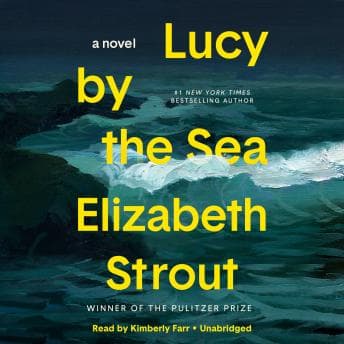

Elizabeth Strout understands something most contemporary novelists don't: silence is a sentence.
I finished this one late on a Sunday night, grading papers abandoned beside me, the apartment quiet except for Denise breathing in the next room. And I sat there for a good ten minutes afterward, not because the ending was shocking—it wasn't—but because Strout had somehow made me feel the weight of those pandemic days all over again. The isolation. The strange intimacy of being trapped with someone you used to love.
What Hemingway Would Have Called "True Sentences"
Lucy Barton is not a character who explains herself. She observes. She remembers. She circles back to the same wounds—her impoverished childhood, her fractured relationship with her daughters, her complicated feelings about William—like a tongue returning to a loose tooth. Some listeners found this repetitive and disjointed. They're not wrong, exactly. But this is what Strout does. She writes the way memory actually works, not in clean narrative arcs but in fragments that accrue meaning through accumulation.
Kimberly Farr's narration matches this perfectly. Her pacing is deliberate—some would say slow, and yes, I listened at 1.0x because the author chose those words and Farr chose those pauses. There's a moment when Lucy reflects on watching her daughters struggle through the pandemic from a distance, and Farr lets the silence after certain sentences stretch just long enough that you feel Lucy's helplessness. The final scene between Lucy and her daughters hit me harder than I expected. Farr doesn't oversell it. She trusts the prose.
The Pandemic Novel Nobody Asked For (That We Probably Needed)
Look, I'll be honest. When I saw this was a pandemic novel, I almost skipped it. We lived through that. Who wants to relive it? But Strout isn't interested in the pandemic as plot. She's interested in what happens when two people who failed at marriage are suddenly confined together in a small house on the Maine coast, watching the world unravel on television while trying to figure out if they still know each other at all.
William is controlling in that way certain men are—convinced he's protecting Lucy when he's really just managing his own anxiety. Lucy is passive in ways that frustrated me, then didn't, then did again. (My students would hate this. They want characters who "take action" and "grow." Sometimes people just survive. That's its own kind of story.)
The prose deserves to be savored. Strout's sentences are so spare they feel almost fragile, like they might break if you read them too fast. This is why audiobook works here—Farr's perfectly modulated delivery gives each observation room to breathe. She doesn't do distinct voices exactly, but she shifts tone when Lucy remembers her mother, or when William is being particularly William-ish. You always know who's speaking.
The Uncomfortable Truth About Privilege
Some listeners found Lucy's perspective from rural safety "superficial and possibly offensive." I understand that critique. Lucy watches the pandemic from a comfortable remove—a house by the sea, an ex-husband with resources, the ability to simply leave Manhattan. She acknowledges this privilege, but acknowledgment isn't the same as interrogation.
Here's what I think Strout is actually doing: she's showing us how guilt and distance create their own kind of suffering. Lucy can't reach her daughters. She can't help anyone. She watches and worries and remembers, and the helplessness becomes its own prison. Is that as hard as what essential workers experienced? No. But it's honest about a particular kind of pandemic experience, and honesty counts for something.
Who This Is (and Isn't) For
Skip this if you need plot momentum or characters who "take action." Skip it if pandemic fiction still feels too raw, or if you want your audiobooks as background noise. But if you loved My Name Is Lucy Barton, this is its spiritual successor—same narrator, same crystalline prose, same willingness to sit with discomfort rather than resolve it. If you haven't read the earlier books, you can start here, but you'll miss some of the accumulated weight of Lucy's history.
Worth Pausing the Faculty Meeting For
At 8 hours and 20 minutes, this is a commitment—but not an unreasonable one. It requires focus. This isn't background listening while you're cooking dinner or pretending to pay attention to budget presentations. (Principal Martinez, I'm reformed now. Mostly.) The introspective pacing means your mind will wander if you're not engaged, and then you'll miss the small moments that make Strout's work so devastating.
Farr's narration is exquisite. Not flashy—she's not doing accents or dramatic flourishes—but precise in a way that serves the material. The complaint about slow pacing? Valid, but intentional. As one listener put it: "Yes the narrator was slow. But so was Lucy." That's not a bug. That's the point.
This is why we still read the classics, and why Strout will be read long after most contemporary fiction is forgotten. She writes about ordinary people with extraordinary attention. And Farr reads her with the respect that attention deserves. That same quality—ordinary lives rendered with devastating precision—is what makes Jane Eyre endure, though Brontë's narrator has more fire than Lucy could ever muster.