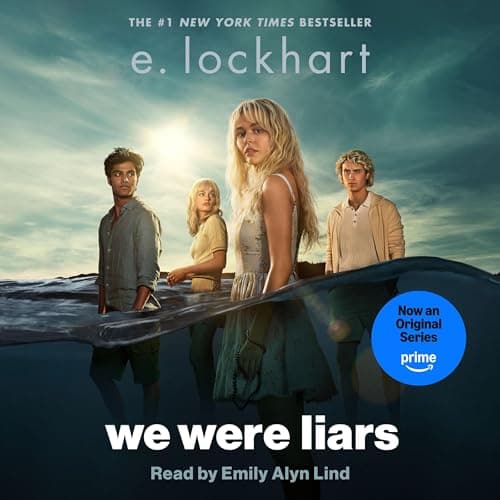

"Welcome to the beautiful Sinclair family." I had this playing through one earbud while folding laundry at 10:45 on a Sunday night, the last civilized moment before Monday and 127 sophomore essays about symbolism. Denise was already asleep. The apartment was quiet except for socks hitting the basket and Emily Alyn Lind sounding like someone telling you a ghost story in a room with all the lights on. Which is exactly the right energy for We Were Liars.
This is a short audiobook, just over six hours, but it asks for your attention in a way a lot of buzzy suspense novels don't. You cannot half-listen while answering emails or pretending to care about a faculty memo. I tried for maybe three minutes. Bad idea. E. Lockhart builds this book out of fragments - migraines, gaps in memory, family rituals, little fairy-tale inserts that sound almost decorative until they very much are not. If you miss a turn of phrase, you miss part of the trapdoor.
Cadence Sinclair Eastman comes from old-money American beauty: private island, summer houses, brittle smiles, and a family so committed to appearances they practically turn emotional repression into a sport. She spends her summers on Beechwood Island with her cousins Johnny and Mirren, plus Gat, the outsider the family never fully knows what to do with. They call themselves the Liars. That name tells you plenty. So does the fact that Cadence returns after an accident with migraines, memory loss, and a feeling that everybody is editing the truth around her.
What this book is really doing
This reminds me of what Hemingway said about omission - leave enough unsaid and the pressure builds underneath. Lockhart writes in clipped, sharp little bursts. Sometimes it reads like poetry scribbled in the margins of a medical chart. Sometimes like a rich kid trying to turn pain into myth because plain speech would hurt too much. My students would hate this. I love it.
And the wealthy-family setting matters. This isn't just "teens with secrets" dressed up in linen. The Sinclair world runs on inheritance, image, and the quiet violence of people who think money excuses moral cowardice. The strongest material here isn't even the twist everyone talks around. It's the way the book keeps asking what privilege does to love - how even affection gets bent by ownership, by race, by who is welcomed into the family photo and who is merely tolerated at the edge of it. I kept thinking about House of Earth and Blood while sitting with these questions - different genre entirely, but it shares that same uncomfortable tension between who belongs and who is quietly assigned a lesser kind of belonging.
Gat is essential to that. Not because he's the brooding romantic add-on, but because his politics and his outsider status expose the Sinclairs for what they are. There's a queasy tension whenever Cadence's love for him collides with the family's polished self-image. The island starts to feel less like paradise and more like a museum built to protect denial.
Also, those fairy-tale passages? They're not cute little literary ornaments. They're the key to the whole machine. Lockhart uses them to translate family greed and emotional cruelty into something fable-like and jagged. By the time the truth arrives, it doesn't feel random. It feels earned. Brutal, but earned.
Emily Alyn Lind knows where the fractures are
Lind's performance is the big reason this works so well on audio. Her voice has that "soft gravel, young whiskey" quality people keep mentioning, and for once the phrase fits. She sounds young enough for Cadence, but not flimsy. There's texture in the voice - a scraped, exhausted quality that makes the migraines and confusion believable without overplaying them.
More important, she understands that pause is punctuation. She doesn't race the fragments. She lets those short Lockhart sentences land one at a time, sometimes with just enough air after them to make you feel the missing information. A lesser narrator might try to smooth the prose out, make it more naturalistic, maybe more traditionally pretty. That would ruin it. This book needs somebody willing to sound slightly off-balance.
And there's an interesting extra layer here: Lind also plays Cadence in the screen adaptation. Usually I don't care much about that kind of marketing symmetry, but here it helps. She seems to understand Cadence from the inside rather than performing her from a distance. You hear charm, yes, but also self-deception. You hear when Cadence is narrating and when she is protecting herself with narration.
I didn't get elaborate character differentiation - no huge vocal fireworks, no theatrical accents, no audio bells and whistles. Single narrator, clean production, no nonsense. For this story, that restraint is smart. The book lives or dies on intimacy and instability, and Lind keeps both right in front of you.
Where it may lose you
If you need a thriller to operate like a clock - clue, clue, reveal, confrontation - this may frustrate you. The middle can feel intentionally fogged over because Cadence herself is fogged over. That's the design, not a flaw, but it does mean some listeners will spend an hour thinking, okay, yes, but where exactly are we going?
And if TikTok sold you on a pure shock machine, adjust your expectations. The twist matters, absolutely. But the real payload is grief. The book lands not because it fooled you, but because once the truth clicks into place, earlier scenes curdle in your memory. A line you thought was dreamy turns desperate. A reunion scene becomes unbearable. Worth pausing the faculty meeting for.
The prose deserves to be savored, too. I listened at 1.0x because this is one of those books where speeding up would flatten the ache. Short sentences aren't the same thing as simple ones.
Who should listen (and who should skip)
Listen if you want a literary YA suspense novel that cares as much about class rot as plot mechanics. Listen if you like unreliable memory, heightened prose, and stories where the setting - Beechwood, the summer houses, the sea, the family dining rituals - is part of the psychology. If you loved One of Us Is Lying but wanted something moodier and more formally daring, this is a strong step sideways.
Skip it if you mostly listen while distracted. Skip it if you want every emotional beat explained in plain language. And skip it if you're allergic to stylized YA prose, because Lockhart goes all in on it.
My last paper-grading thought
We Were Liars is not a puzzle box for puzzle-box's sake. It's a guilt novel wearing a summer-white outfit. Emily Alyn Lind gets that. She gives Cadence a voice that sounds bruised before you know why, and that choice carries the whole audiobook.
Not perfect. Very effective. And nastier, sadder, and smarter than the marketing copy makes it sound.