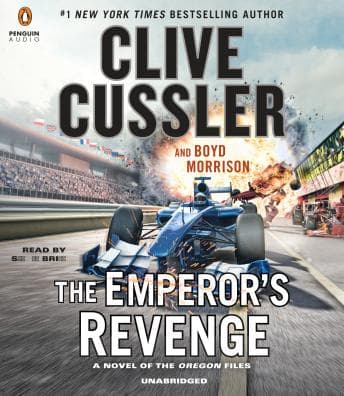

Look, I'll be honest - I picked up Emperor's Revenge because I needed something to listen to during a marathon coding session that had nothing to do with my thesis. (Dr. Patel, if you're reading this, I was definitely working on procedural generation algorithms.) And Clive Cussler's Oregon Files series is basically the literary equivalent of a summer blockbuster - you know exactly what you're getting, and sometimes that's exactly what you need.
But here's the thing. Going into this one, I'd heard it was "confusing" and "had too many plot threads." And I'm sitting here thinking... have these people never run a D&D campaign? Multiple subplots? Shifting goals? That's just a Tuesday night at the gaming table, my friends. That same chaotic energy—though in a much darker register—is what makes Seven H.P. Lovecraft Stories work so well as an audiobook experience.
Scott Brick Is Basically a One-Man Voice Cast
Okay, so Scott Brick. The man has narrated approximately seven thousand audiobooks (slight exaggeration, but barely), and there's a reason he keeps getting hired. His character differentiation is genuinely impressive - and I say this as someone who listens to fantasy epics with seventeen point-of-view characters. You always know who's talking. Always.
There's this quality to his delivery that one reviewer nailed perfectly - he's got "a touch of whimsy to his voice and cadence." And yeah, that's exactly right. It's not campy, it's not over-the-top, but there's this energy that keeps the action sequences punchy and the dialogue snappy. When the Oregon crew is pulling off their heist-within-a-heist nonsense, Brick makes it feel urgent without going full melodrama.
The pacing is spot-on too. Nearly twelve hours could drag in lesser hands, but I genuinely lost track of time. Finished a whole section of (definitely thesis-related) code without noticing three hours had passed.
Napoleon, Hackers, and Economic Collapse Walk Into a Bar
So the plot. A rogue hacker empties the Corporation's bank account during the Monaco Grand Prix. Juan Cabrillo has to team up with an old CIA contact. There's a Napoleonic-era document that could bring Europe to its knees. And somehow it all connects.
I get why some listeners found this convoluted. Morrison and Cussler throw a LOT at you - there are multiple "treasures," shifting allegiances, and the kind of globe-trotting that makes you wish the audiobook came with a map. But honestly? I was into it. The historical elements mixed with modern techno-thriller stuff scratched an itch I didn't know I had. It's like if someone made a heist movie but also threw in alternate history elements. (My D&D group would love this, by the way.)
The weakest moments are when the plot tries to explain the hacker's methodology. Look, I'm a CS grad student. I know how this stuff actually works. And... let's just say "suspension of disbelief" is doing heavy lifting here. But that's fine. This isn't a cybersecurity manual. It's an action romp.
Where It Dragged (Slightly)
I won't pretend it's perfect. There are stretches in the middle where the shifting goals get a bit muddled - you're following one thread, then suddenly we're on a completely different continent chasing a different MacGuffin. If you're listening while distracted (hi, that's me), you might need to rewind a few times.
And the villain's motivation, when it finally clicks into place, is... fine? It's serviceable. It's not Sanderson-level "oh my god everything was connected" revelation. But it works for what it is.
The action sequences, though - those are where Morrison and Cussler shine. There's a set piece involving the Grand Prix that's genuinely tense, and Brick's delivery ratchets up the stakes without becoming exhausting. Edge-of-your-seat stuff, even when I was technically sitting in my desk chair pretending to work.
Queue It or Skip It?
If you're already into the Oregon Files series, this is a solid entry. Not the best, not the worst, but a fun ride. If you're new to Cussler's world, you could probably start here without being too lost - the book does enough setup that you'll catch on to the crew dynamics.
Commuters, this is your jam. Long drives, gym sessions, coding marathons you're definitely not using to avoid your thesis - it's perfect background-but-engaging listening. The kind of book where you don't need to pause when someone interrupts you, but you also won't zone out.
Skip it if you need your plots linear and your goals crystal clear from page one. This is not that book. This is "multiple spinning plates" the audiobook.
Roll for Initiative (Just Kidding, Hit Play)
Scott Brick delivers. The production is clean, professional, no weird audio artifacts or volume inconsistencies. The story is big, loud, and unapologetically fun. Is it high literature? No. Did I enjoy every minute of it while I should have been writing about procedural generation? Absolutely.
Sometimes you want Brandon Sanderson. Sometimes you want Clive Cussler. Both are valid. (Don't @ me.)