
Is there anything more statistically probable than a spouse killing a spouse?
(My criminology professor would say no. My mother, watching her daily soap operas, would definitely say yes.)
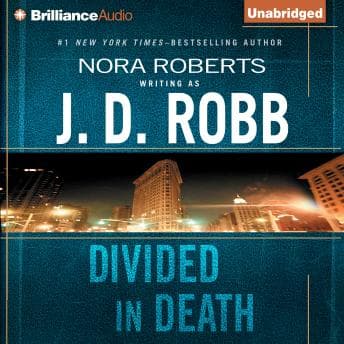
So when I started Divided in Death during my morning loop around Cambridge, I thought I knew exactly what I was getting into. Reva Ewing, former Secret Service, found standing over her husband's body? Classic crime of passion. Case closed. Time to grab a latte.
But here's the thing about human behavior—and J.D. Robb seems to get this better than half the textbooks on my shelf—patterns are comfortable, but anomalies are where the truth hides. Eve Dallas isn't just a cop; she's a behavioral analyst who knows that a woman like Reva doesn't just snap without a serious precursor.
The Voice in My Head (Literally)
I'm going to be honest: I usually struggle with audiobooks that have a lot of characters. My brain tries to map them out like a sociogram, and I lose the thread.
But Susan Ericksen? Wow.
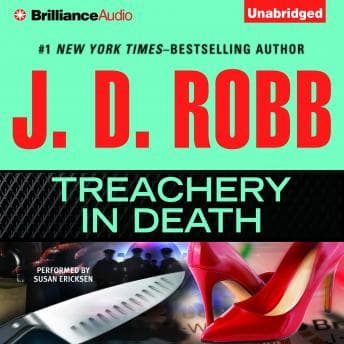
She doesn't just read; she code-switches. She handles the distinct accents and personalities with this terrifying level of precision. There's a specific warmth she gives to Roarke that... well, let's just say it makes the commute way less miserable. And her Eve Dallas? It's gritty, tired, and sharp. It's the voice of someone who has seen too much of the dark side of human nature but still gets up for work.
(I may or may not have zoned out while chopping onions for dinner because I was too focused on her cadence. The onions burned. Worth it.)
When the Motive Doesn't Track
Psychologically speaking, the setup here is fascinating. You have the "jealous wife" narrative—which society loves to eat up—pitted against a techno-terrorism plot. It's 2059, so the tech is advanced, but the motives? Ancient. Greed. Power. Fear.
What hooked me wasn't the computer virus stuff (though the idea of a virus jumping from machine to human is the kind of nightmare fuel I don't need). It was the relationship dynamics. Eve and Roarke aren't just solving a puzzle; they're navigating trust. The way Dallas refuses to accept the easy answer because the behavior doesn't fit the profile? That is competence porn at its finest.
Most authors write characters who do things because the plot needs them to. Robb writes characters who do things because that's who they are. I saw that same character-driven authenticity in Ceremony in Death, where the behavioral consistency is just as satisfying.
Who's This For (And Who Should Skip)
If you like your mysteries with a side of psychological realism and a narrator who could probably read the phone book and make it sound like a thriller, pick this up. Skip it if you need hard sci-fi worldbuilding or can't handle a slow-burn romance subplot threading through your murder investigation.
Case Notes, Closing
Look, is this high literature that I'll be citing in my next paper? No. (My advisor would have a stroke.)
But is it a study in character consistency and suspense done right? Absolutely. Susan Ericksen elevates the material from a standard police procedural to something that feels alive. She nails the emotional beats just as hard as the action sequences.
Ericksen brings that same intensity to Abandoned in Death, where she handles an even darker case with the same precision.
Just maybe don't listen while cooking. RIP to my onions.