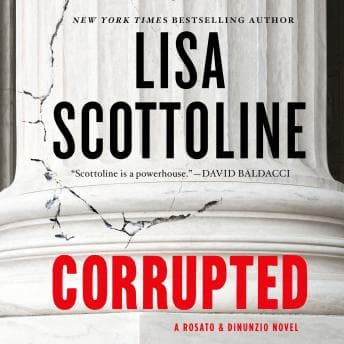

Look, I need to rant for a second. Why does every legal thriller insist on shoehorning in a romance subplot? I'm listening to a story about a woman haunted by the fact that she failed a twelve-year-old kid who got thrown into juvie for punching his bully, and suddenly we're doing... feelings? Romantic feelings? Bennie Rosato is carrying thirteen years of guilt like a body in a trunk, and you want me to care about her love life? Scottoline, I love you, but no.
Okay. Deep breath. Because here's the thing - that complaint aside, Corrupted actually gets something right that most thrillers fumble: the horror of systems. And yes, I'm calling this horror-adjacent, fight me.
The Juvenile Detention Pipeline Is Its Own Kind of Monster
I grew up in a household where the real monsters were the things adults told you were "for your own good." So when Scottoline traces Jason Leftavick's path from a scared twelve-year-old defending himself against a bully straight into the maw of juvenile detention - and then follows the wreckage across thirteen years - it hit somewhere personal. This isn't supernatural dread. It's institutional dread. The kind where the system works exactly as designed, and that's the terrifying part. That particular flavor of dread — bureaucratic, slow, inescapable — is something I kept bumping into in Taken as well, though that book leans harder into the procedural machinery than the human wreckage it leaves behind.
The flashback structure could've been a mess, but Kate Burton navigates the time jumps with this almost surgical clarity. You always know when you're in present-day Bennie vs. younger Bennie because Burton shifts her energy - present Bennie is weary, measured, carrying that guilt in every clipped sentence. The Bennie from thirteen years ago has more heat, more righteous fury. It's subtle but it works. The narrator commits. That's rare.
Scottoline clearly did her homework on the juvenile justice system, and the procedural details are dense. Not in a bad way - in a "you're going to learn something and it's going to make you angry" way. The courtroom sequences are meticulous. Burton's brisk pacing keeps you from drowning in legal jargon, but this is absolutely a focused-listening book. I tried putting it on while shelving returns at the library and missed an entire chunk about evidence tampering. Had to rewind twenty minutes.
Kate Burton Knows Who Bennie Rosato Is
I've said it before on the podcast: narrators are actors. And Burton treats Bennie like a role she's lived in. Her delivery strips away any sentimentality - Bennie's tough exterior isn't performed as "tough woman" posturing, it's performed as exhaustion. As someone who's been fighting too long and winning too little. Burton's read of the elderly Italian-American characters in the supporting cast has this warmth that contrasts sharply with the courtroom coldness, and it grounds the whole thing in a specific Philadelphia world.
Where Burton really earns her keep is during Bennie's inner monologue. There's a lot of it. Legal thrillers live or die on whether you can stand being inside the protagonist's head for eleven-plus hours, and Burton makes Bennie's thought process feel like eavesdropping on someone arguing with themselves at 3 AM. The self-doubt, the second-guessing, the obsessive replaying of old mistakes - it's all delivered with this restrained intensity that kept me locked in.
No sound effects, no production gimmicks. Just clean audio and one narrator doing the work. Sometimes that's enough.
Where the Foundation Cracks
The romance. I mentioned it. I'll mention it again because it genuinely weakens the book. Bennie's emotional arc is already carrying plenty of weight - the guilt over Jason, the reckoning with her own limitations as a lawyer, the confrontation with a corrupt system. Adding a love interest dilutes that. It's like putting a jump scare in the middle of a slow-burn haunting. Wrong tool, wrong moment.
And while the procedural detail is mostly a strength, there are stretches in the middle - around hours five through seven - where the investigative legwork starts to feel repetitive. Burton's pacing helps, but even she can't make the third witness interview in a row feel urgent.
But the core engine works. Jason's story is genuinely affecting, and the question of whether Bennie can save him this time - or whether she's just trying to save herself - gives the whole thing a moral complexity that elevates it past standard courtroom fare.
Who Needs This on Their Shelf
If you're a fan of the Rosato & DiNunzio series, you probably already have this. Burton's consistency across the series means you know exactly what you're getting. If you're new to Scottoline, this is a solid entry point - it's self-contained enough, and the emotional stakes are clear without needing backstory.
If you want action-packed thriller pacing, this isn't it. It's methodical. It's angry in a quiet way. It's a book about what happens when the system chews someone up and the only person who noticed couldn't do anything about it.
I listened to most of this during a late shift at the library, after closing, alone in the stacks. Not because it's scary - it's not - but because the silence matched the book's energy. That institutional quiet. The kind where you can hear the fluorescent lights buzzing.
Shirley (my cat) was unimpressed. But she's never been failed by the juvenile justice system, so what does she know.