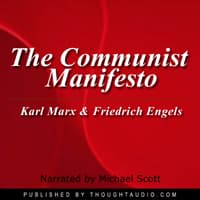

I listened to this on the way to a client site in Palo Alto. The startup is burning cash like it's kindling, and the founders want me to help them "restructure." (That's consultant speak for firing people). So, naturally, I decided to listen to the ultimate guide on overthrowing capitalism. Call it competitive analysis.
My wife Jenny saw this in my queue and asked if I was having a mid-life crisis. I told her I'm just hedging my bets.
Here's the thing about the Communist Manifesto: It's basically a pitch deck. A very aggressive, very early-stage pitch deck for a total market disruption. But instead of "Uber for Dogs," it's "Guillotines for the Bourgeoisie."
The Delivery: Zero ROI on Emotion
Let's address the elephant in the room. The narrator is named Michael Scott.
(No, not the Office character. Though frankly, I would have paid double to hear Steve Carell read this as Prison Mike.)
This Michael Scott? He reads one of the most fiery, incendiary texts in human history like he's reading the terms and conditions for a software update. It is aggressively beige. Michael Scott does the same thing to Book of Revelation—turns apocalyptic fire into elevator music.
Marx and Engels wrote this thing with urgency. It's supposed to be a call to arms. It's supposed to make you want to storm a factory or at least unionize your local Starbucks. But the narration is flat. Monotone. It sounds like he's reading an inventory list of dry goods.
I kept waiting for the "oomph." The anger. The passion. It never came. At one point, I zoned out and started mentally reorganizing my Google Calendar. When a book about violent revolution becomes background noise for scheduling, you have a problem. Scott managed to make Call of the Wild work, though—maybe he just needs wolves and survival stakes to wake up.
The Content: Hustle Culture (1848 Edition)
Setting the politics aside (because I'm not here to debate dialectical materialism), you have to respect the brevity. The whole audiobook is just over an hour.
Most business books I suffer through are 300 pages of fluff wrapping one mediocre idea. Marx and Engels didn't pad the runtime. They got straight to the point. "Workers of the world, unite!" is a solid tagline. Catchy. Scalable.
But listening to this as a guy whose parents ran a dry cleaner in K-Town... it hits weird. My parents worked 14-hour days. They understood "means of production" intimately because they were pressing shirts on them until their hands cramped. They didn't have time for theory. They had rent.
Marx talks a big game about labor, but the text feels academic. The narrator's delivery only emphasizes that distance. It feels like a lecture from a guy who has never actually had to make payroll.
The Efficiency Check
I cranked this to 2.5x speed.
Usually, I do 2.0x, but the narrator's pacing is so deliberate—so slow—that I had to bump it up just to keep my brain from stalling. At 2.5x, Michael Scott sounds almost like a normal human having a conversation. Almost.
Because it's so short (about 30 minutes at my speed), I finished it before I even parked at the client's office.
Who Should Listen (And Who Should Skip)
If you need to know what the Manifesto says for a class, or just to win an argument at a dinner party, sure. Listen to it. It's short enough that the bad narration doesn't become torture. Skip it if you want to actually feel the revolutionary fire—read the text yourself or find a different recording. This version takes a manifesto written in flames and douses it with a bucket of lukewarm water.
Bottom Line
Jenny asked me what I learned. I told her that even revolutionaries need better presentation skills.