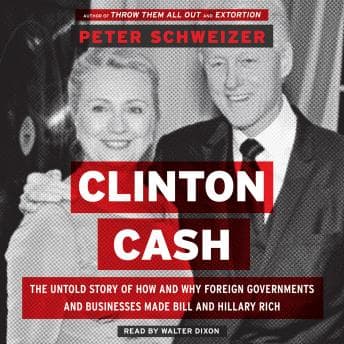

Look, I need to get something off my chest right up front: I am so tired of political books that read like opposition research dressed up as journalism. That's been my gripe with this genre for years, regardless of which side is doing the dressing. So when I started Clinton Cash on a late-night drive back from a client site in San Antonio, I had my skepticism dialed up to about eleven.
Here's the thing though - Schweizer mostly plays it straighter than I expected.
Follow the Money, Not the Outrage
Let me cut to the chase. This book's strength is its structure. Schweizer doesn't waste time with editorial ranting. He picks a country - Kazakhstan, Colombia, Haiti, India, Nigeria - and walks you through the financial trail connecting Clinton Foundation donations, Bill's speaking fees, and Hillary's State Department decisions. It's methodical. Almost clinical. The Kazakhstan chapter alone, where he traces the Uranium One deal and the flow of money from Canadian mining magnate Frank Giustra through various shell entities, is the kind of connective tissue work that would make a decent intelligence briefing.
At 5 hours and 27 minutes, it's lean. No fat. That's both a compliment and a limitation. Schweizer keeps hammering the same pattern - foreign entity needs State Department approval, donations flow to Clinton Foundation, Bill gets a six-figure speaking gig, favorable decision follows - and by the third or fourth iteration, you're either convinced or you're not. He's careful to acknowledge that correlation isn't causation, which is intellectually honest, but it also means the book keeps pulling its punches right when you expect the kill shot.
I've seen this scenario play out in real life - not the political corruption part specifically, but the pattern recognition. In intelligence work, you build a case on patterns of behavior. Three data points is a coincidence. Twelve is a briefing. Schweizer gives you about twenty. Whether you think that constitutes proof or just a really suspicious pile of circumstantial evidence depends largely on what you walked in believing.
Walter Dixon Does the Heavy Lifting
Dixon's narration is workmanlike in the best sense of the word. He reads this like a news anchor who's been doing the job for thirty years - no theatrics, no vocal editorializing, just clean delivery of dense material. When you're dealing with a book that's essentially a series of financial transactions connected by political relationships, you need a narrator who can make "the Clinton Foundation received a $31.3 million donation" land with the same clarity as "and then the State Department reversed its position." Dixon does that.
Is it exciting narration? No. But this isn't a thriller - it's an audit with geopolitical implications. Dixon's consistency is what keeps you tracking the thread from one country to the next without getting lost in the alphabet soup of NGOs, government agencies, and corporate entities. I ran it at my usual 1.25x and it tracked perfectly. Might even handle 1.5x if you're already familiar with the political landscape.
Where the Armor Has Gaps
This is where it lost me in spots. Schweizer's "I'm just presenting facts" posture gets thin when you notice what facts he doesn't present. Counterarguments are mostly absent. Context for why the State Department might have made certain decisions independent of Clinton Foundation money - barely there. He acknowledges alternative explanations exist, then moves on like a lawyer who's scored his point and doesn't want to give the jury time to think about it.
The Haiti section hit me harder than the others, probably because I know guys who deployed there after the earthquake. That same gut-punch of watching real people get ground up by forces bigger than themselves is something One Killer Force captures in fiction form - and somehow that made it hit even harder than the nonfiction did. The allegations about how reconstruction contracts flowed to "Friends of Bill" while Haitians got shortchanged - that's the kind of thing that deserves a full book, not a chapter. It felt rushed, which is ironic for the section that probably has the most human stakes.
Also - and this is a minor gripe - the book was clearly written with the 2016 election cycle in mind. Some of the framing feels dated now, all the "as Hillary prepares for her presidential run" language. Doesn't invalidate the research, but it does remind you this was a weapon, not just an investigation.
Who Needs This Brief
If you're interested in how global money and American political power intersect, this is worth your time regardless of your party affiliation. If you're looking for a balanced assessment of the Clintons' financial dealings, you'll need to pair this with something from the other side of the aisle. And if you can't stomach political books without getting your blood pressure up - skip it, because this one will either confirm your suspicions or make you throw your phone.
Worth your time? Here's the debrief: it's a solid piece of investigative work that stays in its lane - documenting money trails - and mostly resists the temptation to turn into a polemic. The narration serves the material well. At under six hours, it's a one-day commitment. But it's not the complete picture of anything, and it knows it.
Ranger slept through this one. Can't blame him - no explosions.





![Steve Jobs [unabridged audiobook] audiobook cover](/_next/image?url=https%3A%2F%2Fcovers.audiobooks.com%2Fimages%2Fcovers%2Ffull%2F9788499923406.jpg&w=1920&q=75)