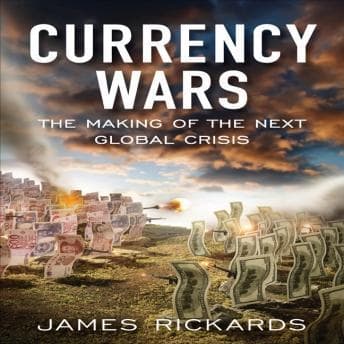

Look, I've sat through enough economic doom-and-gloom books to fill a Bloomberg terminal. Most of them are 80% fear-mongering, 15% recycled Econ 101, and maybe 5% actual insight. So when I started Currency Wars, I was ready to hit that 2.0x button and zone out during my morning commute.
I didn't zone out. Not once.
Rickards opens with something I've never seen in an economics book - a Pentagon war game where he participated as a financial warfare expert. We're talking military brass, intelligence officers, and economists simulating attacks on the dollar. Not theoretical. Actual scenario planning. My parents never had a TED talk about their dry cleaning business, but they understood one thing instinctively: when money becomes worthless, everything else follows. Rickards gets that. He's lived it professionally.
The Part Where History Actually Matters
Here's what separates this from the usual "the Fed is printing money and we're all gonna die" crowd. Rickards breaks down three distinct currency wars - the 1920s-30s, the 1960s-70s, and the one we're in now. And he does it without making you feel like you're back in that macroeconomics class you slept through. The historical sections are genuinely useful. I've seen companies make billion-dollar hedging decisions with less context than this book provides.
The key takeaway is worth the listen. The other 7 hours? Also pretty solid, actually. (Jenny would say I'm being generous. Jenny might be right this time.)
Rickards connects dots that most economists either miss or deliberately ignore. China's gold purchases. Sovereign wealth fund strategies. The Fed's quantitative easing gambles. He's not just describing what happened - he's showing you the game theory behind currency manipulation. I've consulted for three different multinationals on international expansion, and I wish I'd had this framework back then. The strategic thinking here pairs well with the business frameworks in Diary of a CEO, though Rickards operates at a macro level most entrepreneurs never touch.
Walter Dixon Does the Heavy Lifting
Dixon has this authoritative tone that works for dense material. Clear pacing, no stumbling over the economic jargon. He sounds like someone who actually understands what he's reading, which is rarer than you'd think in business audiobooks. Some listeners have mentioned his accent can take a minute to adjust to, but honestly, I barely noticed after the first chapter.
The production quality is clean. No weird background noise, no jarring transitions. For a 10-hour economics deep dive, that matters more than you'd think.
Where It Gets Messy
Okay, so here's my issue. Rickards is clearly brilliant. His analysis is sharp. But the book was published in 2011, and some of his predictions haven't aged perfectly. The dollar didn't collapse. Gold didn't hit $7,000. The financial system, for all its problems, is still standing.
Does that invalidate the analysis? Not really. The mechanisms he describes are real. I've seen the currency manipulation playbook at work in emerging markets. But if you're listening for specific investment advice, pump the brakes. This is framework, not fortune-telling.
The other thing - Rickards can get a bit repetitive. There are sections in the middle where he's essentially making the same point three different ways. At 1.5x speed, it's manageable. At 1.0x? You might start checking your email.
Who Should Listen (And Who Should Skip)
If you work in finance, international business, or policy - this is basically required reading. The Pentagon war game chapter alone is worth your credit. If you're an investor trying to understand macro risks, same deal. Skip it if you're looking for a quick "here's what to do with your 401k" answer. Rickards doesn't give you easy answers because easy answers don't exist in currency markets. That kind of discipline—accepting complexity instead of chasing shortcuts—is what No Excuses! tries to teach, though in a more personal development context. My parents learned that the hard way when the Korean won crashed in '97 and their suppliers' prices tripled overnight.
Bottom Line
This is one of the few economics books that respects both your intelligence and your time. Rickards has actual credentials - he's advised the Pentagon and CIA, not just written op-eds. The historical analysis is solid, the current analysis (for its time) is sharp, and Dixon's narration keeps you engaged through the dense parts.
Is it perfect? No. Some predictions missed. Some sections drag. But for understanding how currency wars actually work - the strategy, the history, the stakes - I haven't found better. Skip to chapter 3 if you want to get past the setup. Thank me later.