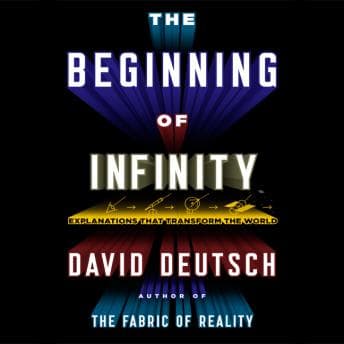

Twenty hours. That's roughly 40 commutes from SF to Mountain View, which means I spent almost two months with David Deutsch in my ears. And honestly? My brain feels like it went through a system upgrade.
Here's the thing about The Beginning of Infinity—it's not really a science book. I mean, it is. There's quantum mechanics and epistemology and evolution. But Deutsch is doing something sneakier. He's basically trying to rewrite your mental operating system. His thesis is wild: explanations are the fundamental unit of progress, and there's literally no limit to what humans can eventually understand and achieve. We're not bounded by anything except the laws of physics, and those laws don't cap our potential.
When Your Commute Becomes a Philosophy Lecture
I'll be honest—the first few chapters hit different at 6AM on a packed Caltrain. Deutsch opens with this whole thing about how bad explanations are "easy to vary" while good explanations are hard to vary, and I had to rewind like three times because my pre-coffee brain kept drifting. But once it clicked? It's like getting a new debugging tool for reality itself.
The book covers an absurd amount of ground. He'll go from the scientific revolution to the multiverse interpretation of quantum mechanics to why optimism is actually the only rational worldview. And somehow it all connects. It's basically distributed systems thinking but for... everything? The way he links knowledge creation to biological evolution to cultural progress—it's the kind of framework that makes you see patterns everywhere.
Some sections are denser than others. The quantum mechanics chapters require actual focus (I switched those to my "working from home" listening queue instead of the train). But then he'll pivot to something like his critique of empiricism or his take on why most societies throughout history were static, and suddenly you're fully awake and arguing with him in your head.
Walter Dixon: The Dramatic Professor
Okay, so Walter Dixon. He's polarizing, and I get why. His delivery is... theatrical. He reads Deutsch like he's narrating an epic, which—look, the content IS epic in scope, but some passages about epistemology don't exactly need the gravitas of a space battle.
That said? I actually think it works for this book. Deutsch's writing is already pretty intense and optimistic, almost evangelical about human potential. Dixon matches that energy. His pacing through the complex arguments is genuinely helpful—he gives you time to process the big ideas without rushing. And his articulation is clean, which matters when you're trying to follow multi-step logical arguments while someone's elbow is in your ribs on a crowded train.
But yeah, if you find dramatic narration distracting, sample this first. I've seen reviews calling it "unlistenable" and others calling it "one of the best narrations ever." There's no middle ground with Dixon. (For what it's worth, after 20 hours I was fully converted. Stockholm syndrome? Maybe. But it worked.)
The ROI Calculation
If you're the kind of person who gets genuinely excited about frameworks and mental models—like, you've read stuff on epistemology or philosophy of science and wanted MORE—this is your book. It's not pop science. Deutsch doesn't dumb things down or pad with anecdotes. He just... argues. For 20 hours.
Perfect for: long commutes, road trips, any situation where you can zone in for extended periods. The ideas build on each other, so you can't really jump around.
Skip if: you want casual listening, something to fall asleep to (you'll miss too much), or anything light after a long day. This is "active listening" territory.
I finished this across maybe 45 commutes, and I'm probably going to relisten to chunks of it. The stuff about static vs dynamic societies, and why the Enlightenment was basically a phase transition in human knowledge creation—that's the kind of material that keeps unpacking the more you think about it.
Speed recommendation: I did 1.5x for most of it, dropped to 1.25x for the physics-heavy chapters. Dixon's pacing is already pretty measured, so you can push it a bit without losing clarity.
Is it perfect? No. Some of his arguments feel more asserted than proven (his multiverse stuff is basically "trust me, this interpretation is correct"). And there are sections where he's clearly grinding an axe against certain philosophical positions. My Confession had that same quality—Tolstoy wrestling with big questions in a way that made me think harder, even when I wasn't fully on board. But even when I disagreed, the disagreement was productive. That's rare.
System Upgrade Complete
The title isn't hyperbole. Deutsch genuinely believes we're at the beginning of infinite progress, and by the end, you might believe it too. Or at least you'll have a much better framework for thinking about why that might be true.





![Steve Jobs [unabridged audiobook] audiobook cover](/_next/image?url=https%3A%2F%2Fcovers.audiobooks.com%2Fimages%2Fcovers%2Ffull%2F9788499923406.jpg&w=1920&q=75)