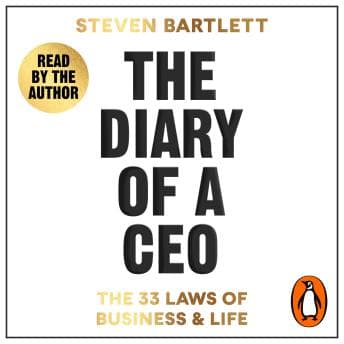

Bottom line: This is a 6-hour-45-minute audiobook with maybe 90 minutes of genuinely useful insight. The rest? Steven Bartlett telling you he's figured out life at 30.
Look, I wanted to like this more than I did. Bartlett built Social Chain from nothing, sold it for millions, became the youngest Dragon on Dragon's Den. The guy has receipts. And his podcast genuinely features some of the sharpest minds in business. So when he packages his "33 Laws" as timeless principles, you expect something substantial.
What you get is... fine. It's fine.
The McKinsey Test (Most Business Books Fail This)
Here's how I evaluate every business book: Would this advice survive a room full of skeptical partners at 2 AM during a client crisis? Would my parents, who built a dry cleaning empire on 14-hour days and zero TED talks, nod along or roll their eyes?
Bartlett's laws fall somewhere in the middle. Some of them - the stuff about filling your "knowledge gaps" before they become failures, the emphasis on environment shaping behavior - that's solid. I've seen companies crater because leadership ignored exactly those principles. But then he'll spend twenty minutes on something that basically amounts to "be curious" or "work hard." (My dad would've charged him for wasting his time.)
The psychology and behavioral science framing is smart. It gives the advice more weight than your typical motivational fluff. But let's be real - most of these "laws" are observations dressed up as discoveries. This is what my parents did instinctively. Now it has a TED talk.
Why Author-Narrated Works Here
Okay, credit where it's due. Bartlett narrating his own book was the right call. His energy is infectious - not in a manic, caffeinated way, but genuinely engaging. You can hear when he's talking about something he actually believes versus when he's padding runtime. The podcast interview clips sprinkled throughout? Those are legitimately valuable. Sometimes more valuable than his commentary on them.
I listened to this during a consulting gig in Austin - lots of airport time, lots of Uber rides. At 2.0x speed, Bartlett's delivery holds up surprisingly well. He's got that natural podcast cadence that doesn't turn into chipmunk chaos when you speed it up. Clean production, no weird audio issues, which sounds basic but you'd be amazed how many business audiobooks sound like they were recorded in a bathroom.
The Depth Problem
Here's where I get harsh. (Jenny would say I'm being harsh. Jenny is right.)
This book is perfect for someone who's never read a business book before. Fresh out of college, starting their first company, needs a framework for thinking about success? Great. Bartlett packages familiar concepts in accessible language with enough personal anecdotes to keep you engaged.
But if you've been in the game for a while - if you've already read Cialdini, Kahneman, Clear, Duckworth - you're going to feel like you're re-listening to the greatest hits with new album art. Character Building gave me that same sense of déjà vu—familiar principles repackaged for a new generation. The "33 Laws" structure feels arbitrary. Why 33? Because it sounds better than 27 or 41. Some laws could be combined. Others feel stretched thin to justify their own chapter.
I've seen this pattern in consulting all the time. Young successful founder gets book deal, reverse-engineers their success into principles, presents correlation as causation. Bartlett is smarter than most who do this - he at least acknowledges uncertainty sometimes - but the format still feels like "things I believe" repackaged as "universal truths."
Skip to the Good Parts
If you're going to commit, here's my advice: the sections on knowledge gaps, environment design, and the stuff about pressure and stress - those chapters earn their runtime. The more abstract philosophical laws? You can skim.
The podcast clips genuinely add value. Hearing fragments from his interviews with actual operators contextualizes his points better than his own explanations sometimes. Smart production choice.
Who Should Listen (And Who Should Skip)
Entrepreneurs in their first five years? Yes. You'll find this motivating and practical enough.
Mid-career professionals looking for a reset? Maybe. Sample first.
Seasoned executives or anyone who's read more than ten business books? Skip to chapter 5. Thank me later. Or honestly, just listen to his podcast directly - the full interviews are often better than the curated highlights here.
Bartlett's got potential as a business thinker. He's young, he's curious, and he's clearly synthesizing from good sources. But this book feels like a snapshot of someone still figuring it out, packaged as someone who's already arrived. Give him another decade of failures and I bet the follow-up will be genuinely great.
For now? It's a solid airplane book. Nothing more, nothing less.









