
I started this at 5:30 AM on a Sunday, halfway through making dosa batter—the kind of meditative kitchen task my mother insists I do wrong. The irony of learning about Buddhist mindfulness while anxiously checking if the batter had the right consistency wasn't lost on me.
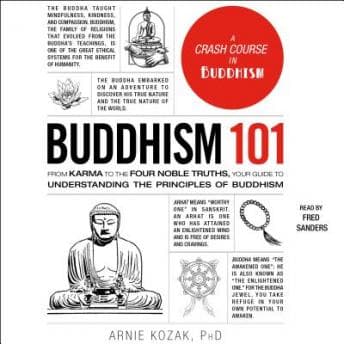
Here's the thing about Buddhism 101 that nobody tells you upfront: Arnie Kozak is a psychotherapist with thirty years of meditation practice, and it shows. This isn't some wellness influencer regurgitating concepts they learned last month. The man has clinical experience at the University of Vermont College of Medicine, and he approaches Buddhist principles like case studies—which, honestly, is exactly how my brain works.
When the Academic Becomes Accessible
Most Western introductions to Buddhism either oversimplify to the point of uselessness or drown you in Sanskrit terminology. Kozak finds a middle path (pun intended, obviously). He breaks down the Four Noble Truths not as abstract philosophy but as a diagnostic framework—suffering has causes, causes can be identified, identification leads to treatment. My therapist would have thoughts about this character, by which I mean Buddhism itself, and how it functions as an early psychological system. The psychological framework here reminds me of the systematic analysis in Ordinary Men, though obviously examining very different aspects of human behavior.
What makes this book compelling is Kozak's integration of mindfulness research with traditional teachings. He doesn't just tell you karma exists; he explains the psychological mechanisms behind why our actions create patterns of consequence. The protagonist here—if we're treating this as a character study—is the Western mind trying to understand Eastern philosophy. And Kozak gets that this mind needs evidence, not just faith.
The Pacing Problem (Because There Is One)
I found myself asking: why does the book lose steam around hour five? The start is genuinely fascinating—the historical context, the core concepts, the practical applications. But somewhere between the Middle Way and the more esoteric teachings, the energy flags. One listener described it as "difficult to finish," and I'll be honest—I had to restart my third batch of chutney to stay engaged.
This is a fascinating case study in how introductory texts often front-load their best material. The Four Noble Truths, karma, mindfulness—these get the most attention and the clearest explanations. Later chapters on more advanced concepts feel like they're checking boxes rather than building genuine understanding. The book doesn't quite know when to end, which is ironic for a text about non-attachment.
Fred Sanders: Competent But Not Transcendent
Fred Sanders delivers the narration with professional clarity. His voice is pleasant, his pacing measured. But—and this matters for a book about a deeply experiential tradition—there's no sense that he's personally connected to the material. He sounds like a very good reader, not a practitioner. For a seven-hour listen on spiritual philosophy, you want someone who sounds like they've actually sat in meditation, not just read about it.
The audio quality is clean, no production issues. But I kept thinking about how different this would sound if Kozak had narrated it himself. The author's thirty years of practice might have brought warmth that Sanders, for all his competence, can't manufacture.
Where the Psychology Actually Tracks
Where Kozak excels is in making Buddhism's psychological insights feel relevant. The discussion of attachment as the root of suffering? That's basically cognitive behavioral therapy's core premise, articulated 2,500 years earlier. The emphasis on present-moment awareness? Hello, every mindfulness-based stress reduction program ever developed.
For psychology enthusiasts—and I'm obviously biased here—this book functions as intellectual history. You can trace direct lines from Buddhist concepts to modern therapeutic approaches. Kozak doesn't belabor these connections, but he makes them visible. It's the kind of book that makes you want to annotate (I have notes, they're extensive, nobody will read them).
Who Should Queue This Up (And Who Should Pass)
If you're a complete newcomer to Buddhism who wants an intellectually rigorous but accessible introduction, this works. If you're interested in the psychological dimensions of Buddhist philosophy, even better. If you're looking for a spiritual experience or a deeply engaging narrative, look elsewhere.
Skip this if you already have a meditation practice and foundational knowledge—you'll find the material basic. Also skip if you need high-energy delivery to stay engaged during long listens.
The Prescription
Buddhism 101 is solid medicine, just not particularly exciting medicine. It does what it promises: explains core concepts clearly, connects them to modern understanding, and respects the tradition without mystifying it. The back half drags, the narration is merely adequate, but the content itself is sound.
I finished it while cleaning up my kitchen at 8 AM, batter finally resting. My mother would say I spent too much time on both the dosa and the Buddhism. She's probably right. But the book reminded me that right effort matters more than perfect outcomes—a lesson I'm still learning, one audiobook at a time.