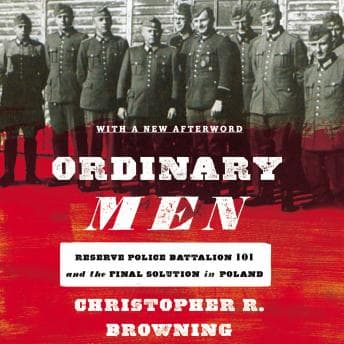

Look, I have a complaint. This book ruined my morning jogs for an entire week. Not because it's bad—it's devastatingly good—but because you can't exactly zone out to your running playlist when you're listening to meticulous documentation of how ordinary German men became mass murderers. I kept stopping on the Charles River path, staring at joggers passing me, thinking: could any of us become this? Would I?
This is the question Christopher Browning forces you to sit with. And sitting with it is deeply, profoundly uncomfortable.
The Milgram Experiment, But Real
Here's what makes Ordinary Men such a gut-punch for anyone who studies human behavior: it's essentially a case study in everything we fear about ourselves. Browning takes Reserve Police Battalion 101—middle-aged German men, working class, not particularly ideological—and traces their transformation into killers responsible for tens of thousands of Jewish deaths in Poland.
The research is meticulous. Almost clinical. And that's what makes it so horrifying.
What struck me hardest was Browning's breakdown of the three groups that emerged: the eager killers (a minority), the reliable followers (the plurality), and the small group who found ways to evade participation without actually stopping anything. That middle group? That's most of us. The research on conformity, obedience to authority, role adaptation—it's all here, but not as abstract theory. As documented behavior. As testimony from the perpetrators themselves.
I kept thinking about Milgram's experiments, about Zimbardo's prison study, about every piece of social psychology research that suggests humans will do terrible things under the right conditions. The hunt for accountability after these atrocities—documented in Churchill's Band of Brothers—shows what happened when some of these men finally faced consequences. But those were experiments. This was real. These were real bullets, real victims, real men who went home to their families afterward.
Kevin Gallagher Gets the Tone Right
Now, about the narration. Kevin Gallagher does something really difficult here—he maintains a serious, respectful tone without becoming monotonous or, worse, sensationalizing the material. The pacing is measured. The pronunciation is clean. He doesn't try to dramatize what's already dramatic enough.
I couldn't find much about Gallagher's other work online, but based on this performance, he understands that with content this heavy, the narrator needs to get out of the way. Let the research speak. And he does. The narration is clear and compelling without ever feeling like he's performing trauma for effect.
Ten hours is a lot to spend with this material. I broke it into chunks—couldn't do more than an hour at a time—and honestly, that's probably the right approach. This isn't background listening. You need to be present for it.
Why This Book Still Matters
My therapist would have a field day with why I'm drawn to books like this. (She'd probably say something about my need to understand human darkness as a way of controlling my fear of it. She wouldn't be wrong.)
But here's the thing: Browning's argument extends far beyond WWII. The mechanisms he identifies—group pressure, diffusion of responsibility, the gradual normalization of violence—these aren't historical artifacts. They're human patterns. They're happening now, somewhere, in some form.
What makes this character study—because that's what it is, really, a character study of an entire battalion—so compelling is Browning's refusal to let us off the hook. He doesn't paint these men as monsters. He paints them as ordinary. And that's the point. The title isn't ironic. It's a warning.
I found myself asking: why does someone who initially vomits at their first killing eventually become efficient at it? Browning has answers. They're not comforting, but they're psychologically sound. The progression from reluctant participant to reliable executioner follows patterns the research actually supports.
Should You Listen?
This is not a casual listen. Full stop. If you're looking for something to half-pay-attention to while doing dishes, this isn't it. The content is graphic—not gratuitously so, but necessarily so. Mass shootings are described. The mechanics of genocide are laid out. You need to be prepared for that.
But if you're interested in Holocaust history, in social psychology, in understanding how atrocities happen—not as aberrations but as predictable outcomes of specific conditions—this is essential. Browning writes with scholarly precision but remains accessible. Gallagher's narration supports rather than distracts.
I finished it three days ago and I'm still processing. Still looking at crowds differently. Still wondering about the gap between who we think we are and who we might become under pressure.
That's what good history does, I think. It doesn't let you stay comfortable.