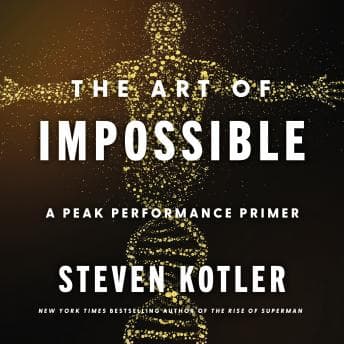

Steven Kotler's The Art of Impossible is basically a psychology textbook dressed up in a self-help trench coat. And I mean that as a compliment — mostly.
I was chopping onions for a chana masala at 10 PM on a Tuesday (yes, the elaborate-meal-for-one lifestyle, don't start), and somewhere between the cumin tempering and the third chapter on intrinsic motivation, I found myself actually pausing to scribble notes on the back of a grocery receipt. That's either a sign the book is doing something right or that I'm losing it. Possibly both.
The Flow Researcher Who Actually Cites His Sources
Here's what surprised me: Kotler doesn't just wave his hands around and say "get in the zone, bro." He structures the book around what he calls four key skills — motivation, learning, creativity, and flow — and builds them sequentially, like a curriculum. The motivation section alone breaks down into three layers: drive (biological), fuel (psychological), and goals (strategic). The protagonist of this book — because let's be honest, Kotler is very much the protagonist — exhibits classic academic rigor while trying desperately to be accessible. He pulls from dopamine research, autonomic nervous system studies, pattern recognition theory. As someone who reads actual papers on this stuff, I was checking his citations in my head and... they mostly hold up.
What makes this framework compelling is the specificity. He doesn't just say "find your passion." He gives you the intersection of curiosity, passion, purpose, and autonomy as a diagnostic. He talks about the neurochemistry of why stacking small wins produces momentum — dopamine, norepinephrine, the whole cocktail. I found myself asking: why does Kotler really structure the book this way? And the answer is that he's treating peak performance like a clinical protocol. Which, as a researcher, I respect.
But — and this is where my BS detector starts pinging — the case studies feel curated to the point of mythology. Every example is an elite athlete or a billionaire CEO who "shattered expectations." The research actually shows that survivorship bias is rampant in this genre, and Kotler doesn't fully escape it. Malcolm Gladwell at least gestures at systemic factors in Tipping Point, even if his case studies have their own curation problem. Where are the people who followed all these steps and still plateaued? Where's the chapter on failure that isn't just a stepping stone narrative? Psychologically, the omission doesn't track. You can't write a book about peak performance grounded in neuroscience and then skip the part where brains resist change for very good evolutionary reasons. Kiese Laymon's Heavy does exactly what Kotler won't — it sits with the body's resistance, the ways our biology and history conspire against transformation, and it's a more psychologically honest book for it.
Fred Sanders and the Enthusiasm Gap
Okay, the narration. Fred Sanders is an Earphones Award winner, and I can hear why — his voice is clean, professional, well-paced. But here's the problem: this book is about peak performance and flow states. It's about passion and neurochemical fire. And Sanders reads it like he's narrating a corporate training manual. There's a flatness to the delivery that creates this weird dissonance. Kotler is writing about dopamine rushes and creative ecstasy, and Sanders sounds like he's reading your company's quarterly report.
I kept thinking about how differently this would land if Kotler narrated it himself. The man clearly lives this material — he runs the Flow Research Collective, he's a former journalist who writes about extreme athletes. That energy doesn't come through Sanders' performance. It's not bad narration in a technical sense. The pacing is fine, the pronunciation is solid. But for a book whose entire thesis is about passion and intrinsic motivation, having a narrator who sounds like he's completing an assignment is — and I hate to say it — counterproductive. My therapist would have thoughts about this irony.
I bumped the speed to 1.25x, which actually helped. Gave the delivery a bit more urgency that the default pace was missing.
Who This Is Actually For (And Who Should Read the Print Version)
This is a fascinating case study in a book being better than its audiobook format. If you've read Rise of Superman and want the practical playbook version — the how rather than the what — this delivers. Kotler's framework for stacking motivation types is genuinely useful. His creativity chapter, where he breaks down the five-stage creative process with specific neurological correlates, is the kind of thing I wish I'd had during my dissertation.
But if you're new to Kotler, or if you need a narrator to sell you on the material, this audio version might actually work against you. The content requires focus — it's dense, structured, and sequential. With a narrator who doesn't quite ignite the material, it becomes work rather than flow. (See what I did there.)
If you're a self-help reader who wants actual science underneath the advice, grab this. If you want inspiration delivered with charisma, read the print.
My Clinical Assessment
Solid science, solid framework, mismatched narrator. Like prescribing the right medication but forgetting the patient needs to actually want to take it. The book itself is a 4. The audiobook experience drops it. Sometimes the delivery system matters as much as the content — a fact Kotler, of all people, should understand.