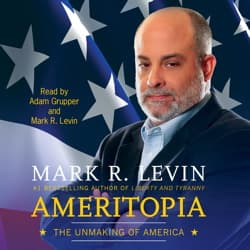

Couldn't sleep last Tuesday. Linda was out cold, Ranger was snoring at the foot of the bed, and my brain wouldn't shut off after a long day of reviewing physical security plans for a client's new headquarters. So I did what I always do at 0200 — threw in the earbuds and started this one. Eight hours later, I'd finished it across two days of windshield time between client sites.
Let me cut to the chase: Ameritopia is basically a political philosophy course compressed into audiobook form, and whether that's a feature or a bug depends entirely on what you're looking for.
Plato to Marx to Your Front Porch
Levin's thesis is straightforward — utopian thinking, from Plato's Republic through Thomas More, Hobbes, and Marx, represents a recurring threat to individual liberty, and that threat is alive and well in modern American governance. The first half of the book is essentially a guided tour through these philosophical heavyweights. Levin walks through Plato's guardian class, More's abolition of private property, Hobbes's all-powerful sovereign, and Marx's stateless endgame with enough detail that you get the core arguments without needing a PhD.
What surprised me — and I wasn't expecting this from a talk radio host — is how much time Levin spends actually engaging with the source material. He's not just name-dropping philosophers to sound smart. He pulls specific passages from Locke's Second Treatise and Montesquieu's Spirit of the Laws to build his counter-argument about natural rights and separation of powers. The section contrasting Tocqueville's observations about American civic life with the centralizing impulses of the utopian thinkers is probably the strongest stretch of the book. Tocqueville warned about "soft despotism" — government that doesn't tyrannize but infantilizes — and Levin connects that directly to modern entitlement expansion. I've seen this scenario play out in real life, not on a battlefield but in how organizations become dependent on centralized decision-making until nobody at the local level can act without permission from above.
The weaker spots? The modern application chapters feel rushed compared to the philosophical groundwork. Levin spends meticulous time with Plato and Locke, then speeds through the contemporary policy parallels like he's running out of runway. I wanted more depth on the specific mechanisms — how exactly does a free society slide into what he's describing? He gestures at it but doesn't give it the same rigorous treatment he gave the classical thinkers.
The Two-Narrator Problem
Here's where it gets interesting. Adam Grupper handles the bulk of the narration, and Mark Levin himself reads certain portions. Grupper is professional, clear, measured — the kind of narrator you'd want for a textbook. But when Levin's voice cuts in, the difference is jarring. Not because Grupper is bad. He's competent. It's that Levin reads his own words with a conviction and urgency that Grupper — understandably — can't replicate. Levin sounds like a man who genuinely believes the republic is on fire. Grupper sounds like a man reading about a republic that might be on fire.
It creates this weird tonal whiplash. You're cruising along with Grupper's steady delivery through the Hobbes analysis, then suddenly Levin's voice hits and the energy spikes. Then back to Grupper. It's like switching between a professor and a preacher mid-lecture. I wish they'd committed to one approach — either Levin reads the whole thing (my preference) or Grupper does. The hybrid undercuts both performances.
Who Should Ruck Up With This One
If you already agree with Levin's political framework, this will feel like intellectual reinforcement with some genuine philosophical depth you might not have encountered before. If you're genuinely curious about the roots of American political philosophy and want something more accessible than reading Locke straight, this works as a primer — just know Levin has a clear thesis and he's prosecuting a case, not moderating a debate.
If you're looking for a balanced examination of progressive and conservative thought, this isn't it. Levin isn't pretending to be neutral, and I respect that more than writers who hide their thesis behind false objectivity. Tired of Winning operates the same way — the author's argument is front and center from page one, and that transparency is something I've come to appreciate more as I get older. But know what you're getting.
This is NOT a background listen. I tried that during a stretch of I-35 traffic and realized I'd completely lost the thread of his Montesquieu argument. You need to be locked in. At 1.25x speed it's manageable, but the philosophical sections demand your attention.
Mission Debrief
Worth your time? Here's the debrief: the philosophical survey in the first half is genuinely valuable and better sourced than I expected. The modern application could've used another chapter or two of the same rigor. The narration split between Grupper and Levin is the audiobook's biggest structural weakness — functional but frustrating. At eight hours, it's not a huge time commitment for what amounts to a crash course in Western political philosophy filtered through a conservative lens.
Ranger slept through most of it, which tells you something about the pacing. But the ideas stuck with me longer than I expected, particularly that Tocqueville section. That's worth something.




![Steve Jobs [unabridged audiobook] audiobook cover](/_next/image?url=https%3A%2F%2Fcovers.audiobooks.com%2Fimages%2Fcovers%2Ffull%2F9788499923406.jpg&w=1920&q=75)