
I was sitting in the break room at 4 AM, trying to eat a granola bar before the next admit rolled in, and I made the mistake of pulling out my earbuds right when Adam Grupper was describing the conditions of Sergei Magnitsky's detention. I just sat there, granola bar halfway to my mouth, staring at the vending machine like it had personally offended me. I've seen what happens when the human body is neglected, abused, denied medical care. I work in a trauma center. And this book still hit me like a freight train.
This Is Not How Justice Works. Trust Me, It's Worse.
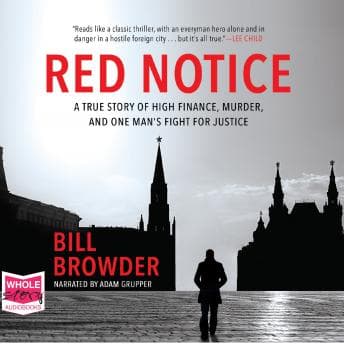
Let me be clear about what Red Notice actually is, because the subtitle and description might trick you into thinking this is a dry financial memoir. It's not. Bill Browder starts as a hedge fund guy making obscene money in post-Soviet Russia - and honestly, for the first few hours, I wasn't sure I was going to like him. He's ambitious, sharp-elbowed, the kind of guy who sees opportunity where most people see chaos. But somewhere around hour four or five, the story pivots hard. Browder gets expelled from Russia. The Russian government goes after his companies, his employees, his lawyer. And then Sergei Magnitsky - a tax lawyer, not a spy, not a soldier, a thirty-seven-year-old tax lawyer - gets arrested for uncovering a $230 million tax fraud committed by the very officials who arrested him.
The section covering Magnitsky's imprisonment is where I lost it. Carlos asked why I was crying in the car. I blamed allergies. But it was the details - Magnitsky writing complaint after complaint from his cell, documenting his own deteriorating health with the precision of someone who still believed the system would work. He had pancreatitis. He was denied medical treatment for months. As someone who's actually worked a code, who's seen what happens when you deny a patient care for hours, let alone months - the medical neglect described here made my stomach turn. And then the beatdown by eight guards. Eight. I've counted ribs on X-rays after assaults. I know what that looks like.
Adam Grupper Earned His Paycheck On This One
The narration is genuinely good, and I don't say that lightly. Grupper handles an absurd range of accents - Russian oligarchs, British lawyers, American diplomats, Polish contacts - and none of them feel like a Saturday Night Live sketch. His Russian accent work is restrained enough to be credible without veering into caricature, which matters when you're narrating real people who really lived (and in Magnitsky's case, really died). He shifts between Browder's wry, sardonic tone in the early Wall Street chapters and the raw urgency of the later political thriller sections without it ever feeling like two different audiobooks.
The one thing I'll say is that at 14 hours, there are stretches in the middle - the financial mechanics of how Browder's fund operated, the specific details of shell companies and tax schemes - where you need to be paying attention. This is not a background-while-doing-dishes listen. I tried that once and had to rewind twenty minutes because I'd gotten lost in a web of holding companies while scrubbing a pot. Night shift brain plus offshore banking structures equals confusion.
When The Real Story Is Scarier Than Any Thriller
Here's what got me. I read medical thrillers all the time. I yell at my dashboard when they get the medicine wrong. But this book? The medical details are accurate. Finally. Except I wish they weren't, because the accuracy means a real person suffered exactly this way. Browder's account of the Magnitsky Act - how he basically became a one-man lobbying machine to get the US Congress to pass legislation sanctioning the Russian officials responsible - reads like a political thriller, but it actually happened. The scenes of him meeting with senators, dodging Russian intelligence operatives, watching allies get intimidated - I kept having to remind myself this wasn't fiction.
And the paranoia is real. Browder describes looking over his shoulder in London, changing routines, worrying about poison. After everything I've seen in the news about Russian dissidents and journalists, none of this felt exaggerated. It felt like a survival manual disguised as a memoir.
Who Needs This In Their Ears
If you're into true crime, political intrigue, or financial thrillers - this is the real thing. If you want something that'll make you angry and informed in equal measure, perfect for that post-shift decompression. My mom would love this (she still thinks I should've been a doctor), and she'd probably call me afterward to discuss Russian politics for an hour.
Skip it if you need light listening or if detailed financial structures make your eyes glaze. This demands your full attention, especially hours 3-7.
Night shift approved. But maybe don't start the Magnitsky chapters at 3 AM when you're already emotionally raw from a rough shift. Or do. Sometimes the real world needs to hit you that hard. On a lighter note, when I need something that won't wreck me emotionally after a hard shift, I keep my review of Dying to Be Me bookmarked — it's the one memoir that actually made me feel hopeful about medicine instead of furious at it.