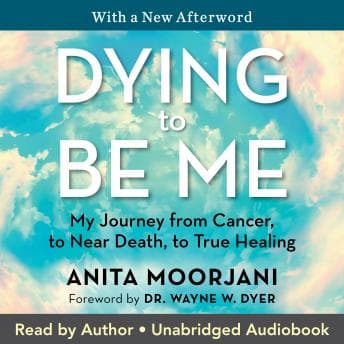

What happens when the author of a book about dying reads you her own story about dying? Something strange, I'll tell you that much.
I was grading sophomore essays on The Great Gatsby at 11:30 PM—the usual parade of "Gatsby was rich and sad" observations—when I decided my brain needed a palate cleanser. Something completely different from Fitzgerald's careful prose. And Anita Moorjani's voice came through my earbuds like she was sitting across from me at my kitchen table, telling me about the time she almost left this world.
When the Author Becomes the Narrator (And Why It Matters)
Here's the thing about author-narrated memoirs—they can go spectacularly wrong. I've heard brilliant writers who sound like they're reading a grocery list. But Moorjani? She understands something fundamental about storytelling that I try to drill into my students: the pause is punctuation.
When she describes her organs failing, when she talks about the moment her consciousness expanded beyond her hospital room, there's this quality in her voice—not theatrical, not overwrought—just... present. Like she's reliving it as she speaks. Her slight accent (she grew up in Hong Kong with Indian heritage) adds texture without ever becoming difficult to follow. It's the kind of delivery only someone who actually lived the story can pull off.
This reminds me of what Hemingway said about writing true sentences. Moorjani isn't performing her near-death experience. She's reporting it.
The Skeptic's Dilemma
Now, I should be honest here. I'm an English teacher. I deal in metaphor and symbol. When Moorjani describes encountering her deceased father during her NDE, when she talks about understanding the "cause" of her cancer as fear and self-rejection, my literary brain wants to categorize this as powerful personal mythology rather than literal truth.
But here's what I kept coming back to: does it matter?
The woman was in a coma. Her organs were failing. Tumors the size of lemons throughout her lymphatic system. And then—medical records apparently confirm this—she recovered with shocking speed. Whatever happened in that liminal space between life and death, something shifted.
The book works on two levels. If you're inclined toward the spiritual, it's a firsthand account of what might await us. If you're more skeptical (like me, grading papers and questioning everything), it's a fascinating psychological document about how confronting mortality can radically alter our relationship with ourselves.
Where the Memoir Gets Preachy (Almost)
I'll admit I was wary when the book shifted into more prescriptive territory. After the NDE narrative, Moorjani discusses what she learned—about self-love, about living authentically, about releasing fear. This is where memoir often becomes preachy, where authors mistake their personal revelation for universal prescription.
Moorjani mostly avoids this trap. Mostly. There are moments where I wished for more nuance, more acknowledgment that not everyone's cancer has the same psychological roots. But her fundamental message—that we spend too much energy trying to be what others expect—lands differently when you've just heard her describe watching her own body from outside it.
At under eight hours, it doesn't overstay its welcome. The 10th anniversary edition adds an afterword about her life since publication, including some discussion of empathic abilities she's developed. Your mileage may vary on that material.
Who Should Press Play (And Who Should Skip)
If you're looking for rigorous medical analysis or scientific skepticism about NDEs, this isn't it. Moorjani isn't interested in proving anything to doubters. She's simply telling her story. Skip this if you need empirical frameworks or if earnest spiritual reflection makes you itch.
But if you've ever wondered what the moment of death might feel like—if you've lost someone and wondered where they went—if you're exhausted from performing a version of yourself that doesn't fit—there's something here. That same kind of earnest, transformative storytelling shows up in Above Life's Turmoil, though it takes a more philosophical route to similar territory about releasing fear and living authentically.
My students would probably call this "woo-woo" and scroll past. But my students also think Faulkner is "too confusing" and that reading is "boring." Sometimes the things that seem too earnest, too vulnerable, too sincere are exactly what we need.
Denise asked me what I was listening to when I finally came to bed at 1 AM. "A woman talking about dying," I said. "It's actually kind of hopeful." She gave me that look—the one that says she's been married to me long enough to stop asking follow-up questions.
Worth Pausing the Essay Grading For
Look, I can't tell you whether Anita Moorjani actually visited some cosmic realm while her body shut down. I can tell you that her telling of it is genuine, her voice carries the weight of lived experience, and the questions she raises about how we live—how we hide ourselves, how we let fear drive us—are the same questions great literature has always asked.
Just in a very different package than I usually recommend to my 47 podcast listeners.
(Mom, if you're reading this, yes, I'm still doing the Faulkner episode next week. No, you don't have to stay awake for it.)