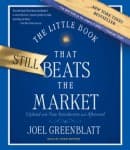

"If you could buy a dollar for 50 cents, would you?"
I was half-asleep on the 6:47 AM Caltrain when Greenblatt dropped this line maybe twenty minutes in, and I actually snorted loud enough that the guy next to me looked up from his laptop. That's the whole thesis of this book, distilled into something so obvious you wonder why you didn't think of it yourself. Spoiler: you probably did, you just didn't have the math to back it up.
The Algorithm That Actually Ships
Here's what I love about this book: Greenblatt treats investing like a debugging problem. You've got a system that's supposed to work (the stock market), but most people get garbage outputs (losing money). Why? Because they're optimizing for the wrong variables. His "magic formula" - and yes, he actually calls it that with zero irony - is basically two metrics: earnings yield and return on capital. Buy companies that score well on both. Rebalance annually. That's it. It's the kind of stripped-down approach I appreciated in Gambler: Secrets from a Life at Risk, where the best strategies are often the simplest ones.
The ROI on this audiobook is insane. Three and a half hours, and you walk away with a quantifiable, backtested strategy that beat the S&P 500 by double digits over 17 years. Could this have been a blog post? Honestly, the core formula could fit in a tweet. But Greenblatt spends the rest of the time doing something more valuable: explaining why it works, why it will keep working even after everyone knows about it, and why you'll probably still screw it up anyway.
That last part hit different. He basically says: "Look, this strategy will underperform the market for months, sometimes years. You'll panic. You'll abandon it. That's why it keeps working - because most people can't handle the variance." It's like he's describing every engineer I know who rage-quit a perfectly good system because the metrics looked bad for one sprint.
Adam Grupper Does the Heavy Lifting
I'd never heard Grupper before this, and he's no Ray Porter - but honestly, for a business book, he's exactly what you need. Calm, confident, zero vocal fry. When Greenblatt cracks a joke about his kids learning about gum companies (it's a whole running example), Grupper delivers it with just enough warmth that you actually laugh instead of cringing at Dad Humor in a finance book.
The pacing is perfect for 1.5x speed. I bumped it to 1.75x during some of the more basic "here's how stocks work" sections - this is definitely aimed at people who don't know what P/E ratios are - but the formula explanation sections deserve normal speed. There's actual math happening, and Grupper keeps it followable even when you're standing in a packed train car trying not to fall into someone's backpack.
No sound effects, no music, no production gimmicks. Just clean narration. Exactly what you want.
The Catch (Because There's Always a Catch)
If you've read any Greenblatt before, or if you've already got a handle on value investing basics, this might feel like a tutorial you don't need. Some reviewers called it "too basic," and yeah - if you're already running DCF models for fun, you're not the target audience. But for everyone else? This is basically "Intro to Quantitative Value Investing" that's actually accessible.
The other thing: Greenblatt wrote this in 2005, updated it in 2010, and the audiobook still references those timeframes. The strategy holds up, but some of the examples feel dated. He talks about screening tools that have been replaced by better options. If you're curious about more current small-cap screening approaches, Little Book Big Profits from Small Stocks covers similar value territory with a different angle. Minor quibble, but worth noting.
Who Should Listen (And Who Should Skip)
Perfect for: Your first real investing book. Anyone who's been meaning to "learn about stocks" but keeps bouncing off denser stuff like Graham's Intelligent Investor. Engineers who want a systematic approach instead of vibes-based stock picking. People with 3-4 commutes to spare.
Skip if: You're an experienced value investor who already knows their Greenblatt. You're looking for options strategies or technical analysis. And if you want day trading tips, this ain't it.
The Commit Message
I finished this in exactly three commutes - one round trip plus a solo morning ride. It's the rare business book that respects your time, delivers a concrete takeaway, and doesn't pad itself with motivational fluff. The formula is simple enough that I actually remember it a week later, which is more than I can say for most books in this category.
Will I actually use the magic formula? Probably not - I'm too lazy to rebalance annually and too chicken to hold during the inevitable drawdowns. But I understand value investing way better now, and that's worth the three hours. Plus, I got a good snort-laugh on the train, which is basically my bar for success.