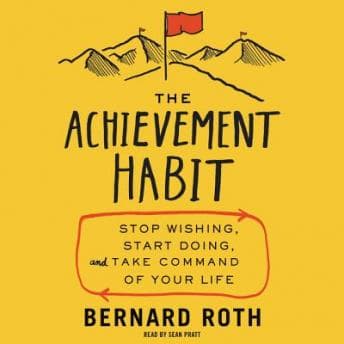

I was stirring a pot of dal at 10 PM—the kind of elaborate cooking I do when I'm avoiding grading papers—when Bernard Roth told me to stop trying and just do. And I actually laughed out loud. Not because it's wrong. Because I've read this exact advice in approximately forty-seven self-help books, heard it from my mother in different words since childhood, and yet here I was, still listening to another book about achievement instead of, you know, achieving things. Man 2.0 Engineering the Alpha had that same recycled-advice energy, though at least it committed to its absurdly specific niche.
But here's what got me. Roth isn't another motivational speaker recycling Tony Robbins. He's a mechanical engineer who co-founded Stanford's d.school, and his approach is genuinely different—he treats personal problems like design problems. You prototype solutions. You iterate. You don't sit around analyzing why you're stuck; you build something and see what breaks.
Why the Design Thinking Angle Actually Works
The research shows that reframing problems changes how we solve them. Roth gets this. His exercises—like distinguishing between reasons and excuses, or asking "what would it do for me if I solved this?"—are borrowed from design methodology, and they're surprisingly effective as psychological interventions. The protagonist here (yes, I'm treating you, the listener, as a case study) exhibits classic avoidance patterns that Roth systematically dismantles.
What makes this approach compelling is its mechanical simplicity. Roth doesn't ask you to feel differently about your problems. He asks you to act differently. Period. The brain follows the body, not the other way around. My therapist would have thoughts about this—specifically, that it's basically behavioral activation dressed up in Silicon Valley vocabulary—but honestly? Sometimes repackaging helps. The same principle applies to relationship advice—Men Are From Mars, Women Are From Venus is essentially basic communication theory repackaged with planetary metaphors, and yet it worked for millions of people who needed that particular framing.
Sean Pratt's narration is clean and professional. Nothing flashy, which suits the material. Roth's writing isn't exactly lyrical—it's an engineer's prose, functional and direct—so Pratt's straightforward delivery matches the content. You're not here for performance; you're here for information transfer.
Where Roth Loses the Thread
Here's my problem. Psychologically, some of this doesn't track. Roth presents achievement as almost entirely a matter of choice and habit formation, which—look, I've spent years studying why people do what they do, and it's messier than that. Trauma, neurodivergence, systemic barriers, depression—these aren't just "excuses" that willpower dissolves. When he dismisses the gap between wanting and doing as purely a matter of commitment, I found myself asking: why does this framework work for Stanford students but might fail spectacularly for someone dealing with actual obstacles?
The book is also lighter than the title promises. Some listeners have called it "just an okay book," and I get that. At seven hours, you'd expect deeper exploration of the neuroscience or more rigorous research backing. Instead, you get anecdotes from Roth's classes, some genuinely useful exercises, and a lot of assertions that feel true but aren't particularly proven. It's a TED talk stretched to audiobook length.
That said—the exercises themselves are worth the listen. The "reasons vs. excuses" distinction alone changed how I talk to myself about unfinished projects. And his point about focusing on what you DO rather than what you ACCOMPLISH (process over outcome) is genuinely valuable for anyone prone to perfectionism paralysis.
Who Should Queue This Up (And Who Should Skip)
If you're already introspective—the type who reads psychology books for fun (guilty)—you'll find some of this basic. But if you're someone who overthinks, who plans endlessly without starting, who has a PhD in self-analysis but can't seem to finish the dissertation? This is a fascinating case study in action-oriented psychology. Roth's engineering mindset cuts through the navel-gazing.
Skip this if you're dealing with clinical anxiety or depression and expecting a cure. This isn't that book, and treating it like one could actually be harmful. But for garden-variety procrastination and goal-setting struggles? It's useful. Not life-changing. Useful.
Case Closed, Dal Finished
I finished the dal. I also finished three emails I'd been "trying" to write for a week. Correlation isn't causation, but Roth would probably say that's exactly the point—stop analyzing, start doing. He understands human nature, at least the parts that respond to behavioral nudges. For the messier parts, you'll need a different book.
Or, you know, therapy. Which I also recommend.