
Okay, let's be real for a second.
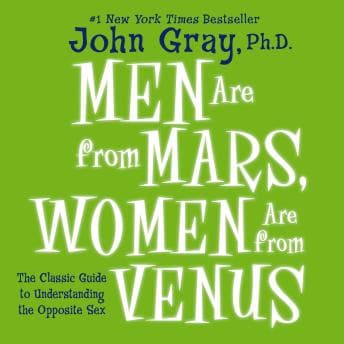
I'm running along the Charles River at 6 AM—mist rising, rowers shouting, the whole Cambridge aesthetic—and I'm listening to Men Are From Mars, Women Are From Venus. Yes, that book. The one my mother has had on her nightstand since 1995. The one that makes my academic brain itch because essentialism is generally a dirty word in my department.
But here I am. Listening to it. (Don't tell my students. Seriously.)
Here's the thing about John Gray. He's not writing for the peer-review board at the Journal of Personality and Social Psychology. He's writing for people who are tired of fighting about why the dishwasher wasn't loaded correctly. And while my research brain screams that gender is a spectrum and human behavior is influenced by a million variables beyond chromosomes, my "I just want to understand why my ex-boyfriend shut down every time I asked him how his day was" brain is... listening.
Let's talk about the Elephant (or the Martian) in the room.
Psychologically? This book is a minefield of generalizations. If you take it literally—that men are biologically incapable of multitasking and women are biologically incapable of stopping a conversation—you're going to have a bad time. It's reductive. It's heteronormative. It treats gender like two distinct species rather than a messy, overlapping Venn diagram.
But.
(There's always a "but," isn't there?)
Heuristics—mental shortcuts—exist for a reason. Gray's concept of the "Cave" (where men go to silently process stress) and the "Wave" (how women's self-esteem fluctuates) are basically just pop-psych branding for avoidant and anxious attachment styles or different processing speeds. And honestly? As a metaphor, it works. When Gray explains that men offer solutions when women just want empathy, I literally stopped running and laughed. Because I do that. I'm the problem. I'm the Martian in that scenario.
So, point for Gray. He captures the patterns of conflict, even if his explanation for why they happen is a bit pseudo-sciencey.
The Narration: A lullaby for your relationship trauma.
John Gray narrates this himself. And wow, is he calm.
He has this soft, gentle, almost hypnotic cadence. It's the voice of a therapist who has heard it all and is no longer capable of being surprised by human folly. That same hypnotic quality shows up in Practical Guide to Self-Hypnosis, though there it's actually the point. On one hand, it's soothing. It feels like he's patting you on the head and saying, "It's okay that you screamed at your husband for breathing too loudly."
On the other hand? It can get sleepy. Fast.
There's very little vocal variation. He doesn't do "voices" for the hypothetical couples. He just... explains. For nine and a half hours. If you're looking for a performance that keeps you on the edge of your seat, this isn't it. This is background audio for cleaning the house or a long drive where you want to stay calm.
I actually had to bump him up to 1.5x speed just to keep my pace up. At 1.0x, I felt like I was wading through molasses.
The Verdict
Look, is this book outdated? Absolutely. It's a time capsule from the 90s. If you're in a queer relationship, or you don't fit strictly into traditional gender roles, a lot of this is going to feel like it's written in a foreign language—skip it.
But if you're in a hetero relationship and keep having the same frustrating miscommunications on repeat? Strip away the planetary gimmicks, and the core advice—validate your partner's feelings and respect their need for space—is actually solid. Building those patterns into your relationship takes the kind of incremental work that Atomic Habits breaks down so well. My therapist would agree with that part, at least.
Just take the "biology" with a massive grain of salt. Or a whole shaker.