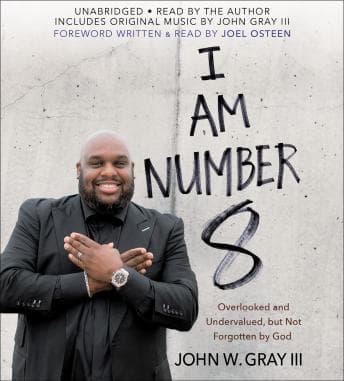

What happens when the person telling you about being overlooked has also lived it?
I was chopping onions for dal at 10 PM—the kind of elaborate cooking-for-one ritual my mother would find deeply concerning—when John Gray started talking about being the invisible kid in his own family. And I stopped mid-chop. Because here's the thing about studying human psychology: you learn to recognize authentic testimony versus performed vulnerability. Gray's delivery? Authentic. Almost uncomfortably so.
The Eighth Son as Case Study
The premise is deceptively simple. David, future king of Israel, was the eighth son—so overlooked that when the prophet Samuel came looking for a future king among Jesse's sons, nobody even thought to mention the kid watching sheep. Gray takes this biblical narrative and does something genuinely interesting with it: he treats David's invisibility as preparation rather than punishment.
The research actually shows that early experiences of being undervalued can go two ways—they either crush someone or create resilience patterns that become superpowers later. Breaking the Habit of Being Yourself explores similar transformation patterns, though from a more neuroscience-focused angle. Gray argues for the latter, and he builds his case through David's story interwoven with his own. The parallels work because he doesn't force them. When he talks about cultivating gifts in obscurity—David learning to fight lions while alone with sheep, developing the slingshot skills that would eventually matter—it tracks psychologically. Competence built in isolation, without external validation, often runs deeper than skills developed under constant observation.
What makes David compelling as a character (and yes, I'm treating him as a character, fight me) is that his "number 8" status wasn't just about birth order. It was systemic invisibility. His own father forgot to present him. That level of dismissal creates specific psychological wounds—and specific strengths.
Gray Reads Gray (And It Works)
Author-narrated books are a gamble. Some authors can write but can't perform. Gray, though—he's a pastor, and it shows. The man knows how to land an emotional beat. When he shifts into testimony sections about his own life, his voice changes. Gets quieter. More hesitant. That's not performance technique; that's someone actually feeling what they're saying.
Listeners apparently cried during these sections, and I get it. I didn't cry (my therapist would have thoughts about my emotional availability, but that's a different conversation), but I understood why others would. There's a rawness to hearing someone say "I was overlooked too" and actually believing them.
He's also genuinely funny. The humor caught me off guard—I'd expected earnest and inspirational, which this is, but there are moments of self-deprecating wit that made me laugh while stirring my dal. The tonal range keeps five and a half hours from feeling like a lecture.
Who Should Listen (And Who Should Skip)
Here's where I have to be direct. If you're not coming from a Christian faith perspective, large portions of this won't land. The framework is explicitly biblical—God's plan, divine timing, spiritual preparation. Gray isn't writing for skeptics; he's writing for believers who feel forgotten by everyone except their God. Skip this if you want secular self-help.
But—and this is interesting—the psychological principles underneath the theology are sound. The idea that obscurity can be developmental rather than just painful? That's backed by research on post-traumatic growth. The concept that skills built without external validation create deeper competence? That tracks with self-determination theory. Gray may not cite the studies, but he's intuitively landed on legitimate psychological territory.
If you're someone who feels perpetually passed over—for promotions, for recognition, for basic acknowledgment—and you want to reframe that experience through a faith lens, this is your book.
Where the Framework Strains
At 5 hours 32 minutes, it's a manageable listen, but some sections feel repetitive. The core message—you're not forgotten, your obscurity has purpose, God sees you—gets restated in multiple ways. For some listeners, that's reinforcement. For others (raises hand), it can feel like circling the same point.
I also found myself wanting more specificity in the practical application. Gray excels at the "why"—why being overlooked might be meaningful—but the "how" of actually moving through those feelings gets less attention. Driven to Distraction does better on the practical front, offering concrete strategies for people who've spent their lives feeling overlooked or misunderstood. My therapist would have thoughts about whether reframing alone is sufficient for healing.
Case Notes
This is a fascinating study in how personal testimony can transform theological teaching. Gray's willingness to be vulnerable about his own "number 8" experiences gives the David narrative weight it wouldn't otherwise have. The audiobook format is the right choice here—his pastoral voice carries emotional information that print would lose.
Is it psychologically rigorous? No. Is it theologically specific in ways that limit its audience? Yes. But for the right listener—someone navigating invisibility through a faith framework—it's exactly what they need to hear, delivered by someone who actually gets it.
The onions eventually got chopped. The dal turned out fine. And I kept thinking about the eighth son, tending sheep alone, becoming someone no one expected.