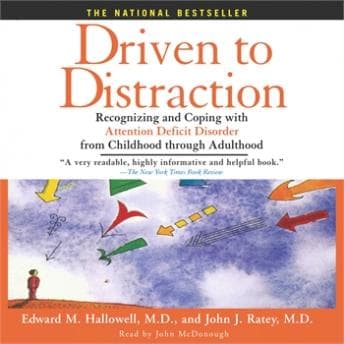

"At times it was as though the author had secretly followed me around for forty years."
That's an actual listener quote, and honestly? It captures something I've been trying to articulate about this book for days. As someone who studies how people construct narratives about themselves—how we explain our own behavior, our failures, our weird little quirks—Driven to Distraction hit me in a way I wasn't expecting.
Look, I picked this up for research purposes. I'm working on a paper about self-diagnosis narratives and identity formation. Very dry academic stuff. But somewhere around hour three, I stopped taking notes and just... listened. While making dal that I definitely overcooked because I forgot to check the stove. (The irony is not lost on me.)
The Psychology of Finally Being Seen
What Hallowell and Ratey do here is essentially clinical validation through storytelling. And as a researcher, I have to say—they understand something fundamental about how humans process information about themselves. They don't lead with diagnostic criteria or neurological mechanisms. They lead with stories. Case studies of real people who thought they were lazy, undisciplined, somehow fundamentally broken.
The protagonist in each case study exhibits classic shame spirals. Years of being told they're not trying hard enough. Decades of compensatory behaviors that worked until they didn't. And then—the diagnosis. The reframing. The "oh, so that's why" moment.
Psychologically, this approach is brilliant. You can't argue someone into accepting a diagnosis. But you can show them a mirror. And that's what this book does, over and over, for thirteen and a half hours.
The Narrator Situation (Let's Talk About It)
Okay, so. John McDonough. Here's the thing—his voice is genuinely pleasant. Soothing, even. Dignified in a way that makes you feel like you're being taken seriously, not talked down to. Which matters enormously for a book about a condition that's been dismissed and mocked for decades.
But.
There's a deeply ironic problem here. The narration is slow. Like, noticeably slow. And this is a book about attention difficulties. I found myself drifting during some sections, which—again, the irony. One reviewer mentioned having to restart parts because the relaxing tone was almost too effective. I experienced this exactly once, during a particularly dense chapter on childhood manifestations, and I was running through Cambridge at the time so I'll give myself partial credit.
My recommendation? Bump it to 1.25x speed. Maybe 1.5x if you're comfortable with that. The content is dense enough that you won't miss anything, and the pacing feels more natural.
What the Research Actually Shows (And Why This Book Still Matters)
Here's where I put on my academic hat for a second. This book was originally published in 1994 and revised in 2011. The field has evolved. We talk about ADHD differently now—the inattentive type, the hyperactive-impulsive type, the combined type. Executive function. Dopamine regulation. The research has gotten more sophisticated.
But what makes this book compelling is that it's not really about the science. It's about the phenomenology—what it feels like to live with this brain. And that hasn't changed. The shame hasn't changed. The compensatory strategies haven't changed. The relief of finally having a name for the thing that's been making your life harder than it should be—that definitely hasn't changed.
Hallowell writes from lived experience. He has ADHD himself. And you can feel that in the compassion woven through every case study, every explanation, every gentle correction of misconceptions. This isn't a researcher studying subjects from a distance. This is someone who gets it.
Who Should Listen (And Who Should Skip)
Best for: Anyone who's wondered if their chronic disorganization, their inability to finish projects, their tendency to zone out during important conversations might be something more than a character flaw. Also excellent for parents, partners, teachers—anyone trying to understand someone with ADHD.
Understanding the people in our lives is something 5 Love Languages: The Secret to Love that Lasts approaches from a different angle—less about neurology, more about communication patterns—but the underlying goal is the same: seeing why people do what they do.
Skip if: You need fast-paced delivery to stay engaged and aren't willing to adjust playback speed. Or if you're looking for cutting-edge neuroscience rather than foundational understanding.
I found myself asking: why does this book, published decades ago, still feel so relevant? And I think the answer is that Hallowell understood something the research is only now catching up to—that ADHD isn't just a disorder of attention. It's a disorder of self-regulation, of emotional management, of the stories we tell ourselves about who we are and why we fail.
The production is clean. No audio issues. Just you and McDonough's measured voice walking you through what might be the most important reframe of your life.
I laughed. I cried. And this is the unexaggerated truth—that's a direct quote from another listener, but I'm borrowing it because it's accurate. My therapist would have thoughts about how much I related to some of these case studies. (I'm not going to tell her. She doesn't need more material.)