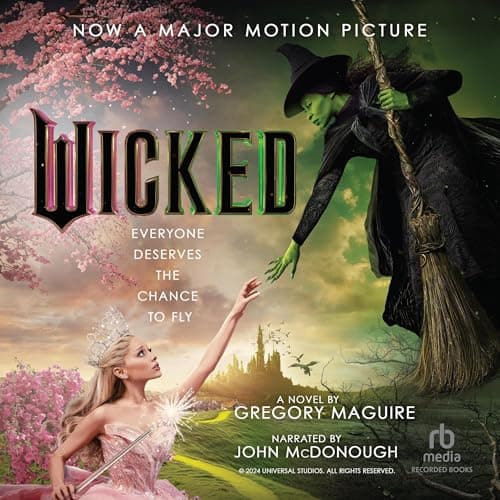

Somewhere around hour three, halfway through a stretch of I-95 with nothing but pine trees and construction cones, John McDonough said something as Elphaba and I genuinely couldn't tell if it was supposed to sound wounded or bored. That's when the central tension of this audiobook clicked into focus for me: a technically skilled male narrator trying to inhabit a fiercely, uncompromisingly female story, and the gap between effort and success widening every time a woman opens her mouth.
Let me back up. Gregory Maguire's Wicked is not the musical. If you're arriving fresh from "Defying Gravity" and expecting a feel-good sisterhood arc, the book will greet you with something closer to a philosophy seminar held in a famine-stricken police state. This is literary fiction in a fantasy costume — dense with political allegory, religious hand-wringing, and moral ambiguity that the stage version carefully sanded away. Elphaba isn't just misunderstood; she's genuinely difficult, prickly, often passive in ways that test your patience and your sympathy. The Oz here is drought-stricken and corrupt, its Wizard running secret police while Animals — capital A, meaning creatures with sentience and speech — face systematic persecution. It's uncomfortable in ways that feel deliberate and earned.
McDonough's voice has a warm, slightly professorial quality that actually suits Maguire's elaborate prose better than you'd expect. When he's painting the world — the seedy underbelly of the Emerald City, the austere halls of Shiz University, the desolate Vinkus — his pacing and tone create genuinely vivid imagery. One listener described being "utterly enchanted," and during the descriptive passages, I get it. There are stretches where his reading feels like sitting with a patient, slightly wry professor who loves this material and wants you to see what he sees.
But here's where it falls apart for me, and I say this as someone who listens to a lot of single-narrator audiobooks: the female character work lacks distinction. The distinction problem isn't unique to McDonough — I noticed similar flattening in how narrators handle ensemble casts when I reviewed Driven to Distraction, though there it mattered far less because the voices weren't carrying emotional weight the way Glinda and Elphaba need to. Elphaba, Glinda, Nessarose — they blur together vocally. In a book where the most important relationships are between women, where the emotional architecture depends on hearing the difference between Glinda's social performance and Elphaba's raw honesty, that blurring costs you something real. I had to rewind multiple times to figure out who was speaking during dialogue-heavy sections. One reviewer put it bluntly: it "felt like he was reading the book for the first time, getting every line wrong." That's too harsh for the full performance, but during certain passages where inflection choices work against the text rather than with it? Not entirely unfair.
The polarization around McDonough is striking. Some listeners report his voice causing genuine physical irritation over long sessions — not metaphorical discomfort, but actual grating. I didn't experience that, but at nineteen-plus hours, I did notice fatigue setting in during the slower philosophical stretches where the narration couldn't quite carry the weight of Maguire's tangents about the nature of evil or Animal rights politics. And yes, multiple listeners flagged what appear to be stomach noises in the recording. Minor, but once you hear it, good luck unhearing it.
Here's what I discovered on that road trip: this audiobook punishes distraction. Maguire's prose is not forgiving. He'll spend pages on a philosophical tangent, and if you zone out during a lane change, you'll come back completely lost. The pacing mirrors the book's structure — Elphaba's life told in distinct phases with wildly varying momentum. The university years crackle with energy and social intrigue. Other sections feel like wading through something thick and resistant, not unpleasant exactly, but demanding in a way that doesn't suit half-listening.
The book itself remains a fascinating, frustrating, sometimes brilliant piece of revisionist fiction. Maguire built something genuinely original inside L. Frank Baum's world — a story about what it costs to be the person who sees injustice clearly and can't look away, even when looking away would save her. That's the emotional core that makes Wicked worth the difficulty. McDonough's smooth delivery makes the denser passages more digestible when spoken aloud, even as his limitations with the female cast occasionally flatten the moments that should hit hardest.
Who Should Listen (And Who Should Skip)
If you've already read Wicked in print and want to revisit it, McDonough adds genuine warmth. His warmth actually translates well across genres — I heard the same quality in his work on New Song, where that professorial steadiness turned out to be exactly the right register. If you're new to the book, just know that the distance between this story and the musical is vast, the content is adult in both senses, and this is the kind of audiobook that asks you to meet it more than halfway. Skip this if you want a breezy listen or if vocal distinction between female characters is a dealbreaker — you'll spend too much time rewinding and not enough time feeling. For what it's worth, listeners who moved on to the sequel Son of a Witch, narrated by Maguire himself, largely agreed that McDonough was the better narrator. So there's context for the performance — imperfect but clearly the stronger option available.