
So here's the thing - I went into this expecting a quaint little historical fiction piece, something to half-listen to while my advisor's latest email about "timeline concerns" stared at me from my inbox. What I got instead was a heist story. For kids. Set during the Nazi occupation of Norway. With sleds.
I know, I know. It sounds like the setup for a D&D one-shot I'd run after three energy drinks. But Marie McSwigan based this on real events, and honestly? The premise is so audacious it circles back around to brilliant.
The Heist That Shouldn't Work (But Absolutely Does)
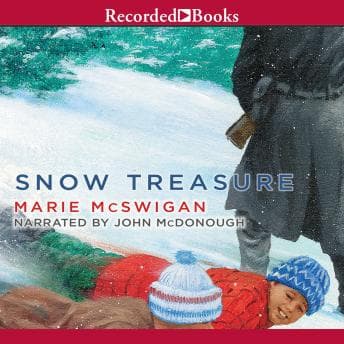
Peter Lundstrom and his friends have to smuggle nine million dollars in gold bullion past Nazi soldiers. Their cover? They're just kids sledding. That's it. That's the plan. And look, if one of my players proposed this in a campaign, I'd make them roll with disadvantage. But McSwigan sells it completely.
The tension comes from how ordinary everything has to look. These aren't action heroes - they're children pretending to play while their hearts are pounding and their sleds are weighted down with their country's entire treasury. Every interaction with a German soldier becomes this knife-edge moment. Will they notice the sleds are too heavy? Will Peter's nervous face give them away?
John McDonough gets this. His narration leans into the suspense without going full melodrama. When Peter has to chat casually with guards while gold bricks sit under a thin layer of snow, McDonough's voice carries just enough tension that you feel it in your chest. He's not doing wild accent work or theatrical flourishes - he's playing it straight, which is exactly what a story like this needs.
Why This Hit Different at 2 AM
I was supposed to be working on my thesis chapter about procedural generation in roguelikes. Instead I found myself genuinely invested in whether a bunch of Norwegian kids were going to successfully commit what is technically grand larceny against an occupying force. (The Nazis are the bad guys, obviously, but still - these kids are running a smuggling operation. Respect.)
At just over four hours, this isn't asking for a massive time commitment. I burned through it in two sessions - one while avoiding my advisor's office hours, one while my roommate's cat judged me from across the room. The pacing is tight. McSwigan doesn't pad things out with unnecessary subplots or extended flashbacks. The mission is the story, and the story keeps moving.
What surprised me was how well the stakes translated. This isn't a fantasy epic with world-ending consequences spelled out in prophecy. It's smaller and more personal - these kids are scared, they're doing something dangerous because the adults in their lives asked them to, and failure means something worse than a bad grade. It's the kind of stakes that actually land because they feel real. That same grounded tension shows up in Strange Case of Jekyll and Hyde (Version 4 - Dramatic Reading), where the horror works precisely because it's personal and immediate rather than cosmic.
The D&D Table Comparison (Because Of Course)
My gaming group would absolutely try to run this scenario. I can already see Jake insisting his character could hide more gold if he just "optimized the sled weight distribution." But that's actually what makes Snow Treasure work - it's the kind of story where the plan is simple, the execution is terrifying, and success depends entirely on keeping your cool.
McDonough handles the ensemble of kid characters well enough. You're not getting Steven Pacey-level distinct voices for every single child (that's a high bar, to be fair), but Peter comes through clearly as the protagonist, and Uncle Victor has this steady, reassuring quality that makes you understand why the kids trust him with their lives.
The Missing Pieces
I'll be honest - this is a book from 1942, and it shows in some ways. The characterization is functional rather than deep. You're not getting complex internal arcs or morally gray territory. The Nazis are bad, the Norwegians are brave, and the kids are heroic. It's straightforward in a way that modern middle-grade fiction often isn't.
But sometimes straightforward is what you need. Not every story has to be a 40-hour Sanderson epic with seventeen magic systems and a wiki to keep track of the worldbuilding. Sometimes you just want to root for some kids outsmarting fascists with sleds.
Who Should Queue This Up (And Who Should Pass)
If you've got kids who are ready for some WWII history but not ready for the full weight of it, this is a solid entry point. It's tense without being traumatic, historical without being dry. Teachers and parents looking for something to supplement history lessons - this is your audiobook. Skip it if you need deep character work or moral complexity; that's not what this is doing.
For adult listeners? Look, if you're in the mood for something light that still has actual stakes, this works. It's not going to blow your mind, but it's a well-executed adventure story that respects its audience. I listened to it instead of writing my thesis, and I regret nothing.
Roll for Initiative
Snow Treasure is a nat 20 on a stealth check. Simple premise, solid execution, surprisingly effective tension. McDonough's narration keeps things moving without overselling the drama. It's not going to replace your favorite epic fantasy, but as a palate cleanser or a quick listen between heavier stuff? Yeah. This one's worth your time.