
Mitford is the literary equivalent of comfort food, and I don't mean that as an insult.
I'll be honest. I came to Jan Karon late. My wife Denise has been reading the Mitford books for years — she keeps a battered paperback of At Home in Mitford on her nightstand like some people keep the Bible. So when she handed me her earbuds during a Saturday lakefront walk and said "just try ten minutes," I figured I'd humor her. Seventeen hours later, I'm writing this review at 11PM with a cup of tea that's gone cold and a stack of ungraded essays staring at me with judgment.
The Small-Town Novel That Hemingway Would've Secretly Loved
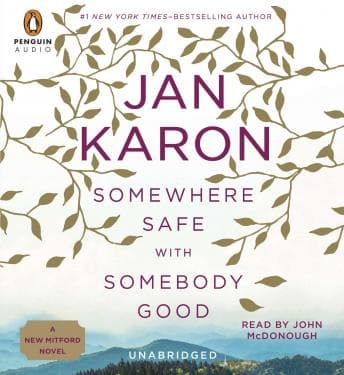
This reminds me of what Hemingway said about writing — that the dignity of movement of an iceberg is due to only one-eighth of it being above water. Somewhere Safe with Somebody Good moves like Mitford itself: slowly, deliberately, with the weight of everything unsaid pressing underneath the surface. Father Tim Kavanagh has retired from Lord's Chapel, returned from Ireland, and now faces a question that's frankly terrifying for a man whose entire identity was built around serving: What do you do when you're no longer the one people need?
Karon doesn't rush this. She lets Father Tim circle the emptiness of a life without a pulpit the way real people circle their anxieties — through small talk, through errands, through showing up at the bookstore and the café and pretending the ache isn't there. When he's offered a new pulpit and turns it down, it's not dramatic. It's quiet. And that quiet is where the real emotional work happens.
But the book isn't a one-man show. There's Sammy — Dooley's brother, still burning with the kind of rage that comes from being abandoned by your mother — who destroys one of Father Tim's prized possessions. That scene hit differently than I expected. I've taught enough angry teenagers to recognize the specificity of Karon's writing there. She doesn't dramatize it. She just lets the damage sit in the room. Then there's Hope Murphy, the bookstore owner facing the potential loss of both her unborn child and her business, which is exactly the kind of overlapping crisis that fiction usually separates into tidy subplots but real life smashes together.
And yes — a romance that kindles through an Internet word game. My students would hate this. I love it. There's something so genuinely charming about two people falling for each other over vocabulary that it almost reads as a love letter to readers themselves.
John McDonough Knows the Speed of This Town
Here's where I have to be upfront: the research on McDonough's specific performance here is thin. I can't point you to a dozen detailed breakdowns of his accent work or character voices. What I can tell you is this — after seventeen-plus hours with the man, his voice becomes Mitford. He has a warmth to his narration that feels less like performance and more like a neighbor telling you what happened this week over the back fence.
His Cynthia — Father Tim's wife — has an authentic quality to her that several listeners have flagged as a particular strength, and I agree. She comes across as sharp and loving and a little exasperated, which tracks perfectly with how Karon writes her. The same kind of warm, lived-in romantic dynamic caught me off guard in Naked Love — two people whose chemistry lives in the small moments rather than the grand gestures. The narrator understands that pause is punctuation, and in a book this quiet, the pauses matter more than the climaxes. He doesn't try to make Mitford exciting. He lets it breathe.
At 1.0x speed — and yes, I listened at 1.0x because the prose deserves to be savored — the pacing felt right. This is not a book that rewards rushing. You're not listening for plot twists. You're listening for the texture of a community holding itself together through small acts of decency.
Who Gets to Come to Mitford (And Who Should Stay Home)
Let me be direct. If you need a plot engine firing on all cylinders, this isn't your book. If you're new to the Mitford series, starting at book ten is like walking into the faculty lounge mid-conversation — you'll get the gist, but you'll miss the history. This is a book for people who already love these characters or who understand that a novel can be about whether a small town still takes care of its own and make that question feel enormous.
If you loved Middlemarch — and I say this as someone who listened to it during a particularly dull budget presentation — this is its spiritual successor in miniature. Smaller scale, less Victorian ambition, but the same fundamental interest in how ordinary people navigate ordinary crises with imperfect grace.
Denise finished it before me. She cried at the end. She won't tell me why. (She says it would be a spoiler. I think she just likes having something over me.)
Worth Pausing the Faculty Meeting For
Seventeen hours is a commitment. But the Mitford books aren't really about finishing — they're about inhabiting. This is why we still read the classics, and why some contemporary fiction earns its place alongside them: because they remind us that small lives, closely observed, are never actually small. Father Tim's crisis of purpose, Sammy's fury, Hope's fear — none of it is epic. All of it matters.
My 47 podcast listeners would appreciate this. My mom would definitely fall asleep. But she'd wake up feeling better about the world, and honestly, that counts for something.