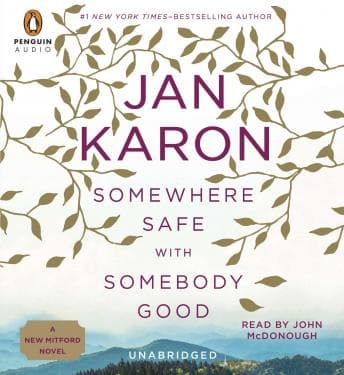
What happens when you spend nearly 18 hours with people who aren't real but feel more like neighbors than half the people on your actual street?
I'll tell you what happens. You start worrying about their bank accounts. You start hoping a five-year-old's birthday party goes well. You find yourself invested in whether a small-town newspaper editor's pork-chop marinade can save his marriage. And you don't even question it.
Mitford Is the Anti-Trauma Center (And I Mean That as a Compliment)
Look, I spend my nights elbow-deep in the kind of human suffering that would make Jan Karon's gentle little town implode. So when I say To Be Where You Are was exactly what I needed on three consecutive post-shift drives home plus a Saturday morning when I was supposedly folding laundry but really just sitting on the couch with my eyes closed - I mean it. This book is warm milk and a clean blanket. It's not trying to shock you. It's not racing toward some twist. It's book fourteen in a series, and it knows exactly what it is.
Father Tim Kavanagh, now well into retirement, is still wrestling with purpose - something I think about more than I'd like to admit at 3 AM when the unit goes quiet and I wonder what I'll do when my body can't handle nights anymore. His struggle isn't dramatic. There's no crisis of faith montage. He just... keeps showing up for people. And that hit different coming off a shift where showing up is literally the whole job.
The Dooley and Lace storyline - the newlyweds dealing with a financial crisis at their vet practice while raising adopted son Jack - gave the book its emotional spine. Jack's big day, this birthday party that the whole community rallies around, builds so slowly and quietly that when it arrives, it carries this enormous weight. Carlos asked why I was crying in the car. I blamed allergies. In July. In Phoenix. He didn't buy it.
John McDonough Knows These People Better Than They Know Themselves
Here's what surprised me: I came into this as a series outsider. Never read a Mitford book. And McDonough's narration made me feel like I'd been here for all fourteen. His pacing is deliberately slow - and I mean deliberately, not lazily. He leaves space between lines of dialogue the way real conversations have pauses. Father Tim sounds like a man who's earned every wrinkle, with this warm, slightly tired quality that never tips into frailty. The folksy Mitford residents each get their own rhythm - J.C. Hogan's newspaper-editor bluster versus the gentler cadence McDonough gives Lace.
At 17 hours and 48 minutes, this is a commitment. But McDonough treats it like a long dinner with old friends, not a marathon. The man has narrated this series for years and you can tell. There's a continuity here, a confidence, like he doesn't need to prove anything. He just inhabits it.
I will say - at 1x speed, some of the slower domestic scenes (there's a stretch involving town politics and the former mayor running for office again) tested my patience. I bumped to 1.15x for maybe an hour, then dialed it back because I felt guilty. Like I was rushing someone's grandmother.
This Is Not a Book That Happens To You
Let me be straight. If you need plot, if you need momentum, if you need something to keep you awake on a dark highway - this is not it. This is not a thriller. There's no mystery despite the playful "who died?" tease in the description (it's a town character's obituary, and it's handled with more sweetness than suspense). The stakes here are emotional and domestic: Will Dooley's estranged family heal? Will the vet practice survive? Will the birthday party have enough food?
And somehow, those stakes felt enormous. The only other time I've felt that kind of weight attached to purely domestic stakes was reading White Fang — survival stripped down to its most elemental form, and somehow just as gutting.
Jan Karon writes community the way I experience it at the hospital during a good shift - people annoying each other, loving each other, showing up with food when things go wrong. The "miracle" at Jack's birthday involves a game that reconnects Dooley's fractured biological family, and it's written with such restraint that it earns every bit of its emotion. No manipulation. Just people being decent to each other, which - after the things I see at work - felt almost radical.
My mom would love this. She still thinks I should've been a doctor, but she's also the kind of person who'd adopt every character in Mitford and feed them all rice and adobo.
Who Gets a Prescription and Who Should Walk
This is for: Mitford series fans (obviously), anyone who loves character-driven fiction where nothing explodes, listeners who want a warm companion for long commutes or quiet evenings, and anyone in a high-stress profession who needs fiction that actively lowers your cortisol.
Skip if: You need pace. You need stakes that involve actual danger. You haven't read any Mitford books and don't have patience for catching up on 13 books' worth of relationships (though McDonough helps more than you'd expect).
Night Shift Approved - With a Caveat
Perfect for that post-shift decompression. Just don't start it when you need to stay alert. This book wants you to relax, and it will succeed.