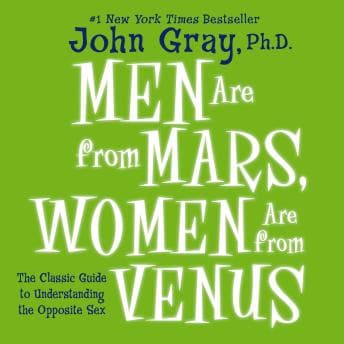

I was making a vindaloo that was arguably too spicy for a Tuesday night, trying to drown out the silence of my apartment, when I decided to put on John Gray. Yes, that John Gray. The Mars and Venus guy. I'd already listened to Men Are From Mars, Women Are From Venus, so I knew what I was getting into with his whole planetary metaphor situation. My therapist has been suggesting I look into "relationship dynamics" (her polite way of saying I analyze men to death instead of dating them), so I figured, why not go to the source?
This isn't my usual fare. I'm usually dissecting the twisted motivations of a thriller protagonist or reading dry academic journals on narrative identity. But sometimes you need to step out of the ivory tower and listen to what the rest of the world has been buying for thirty years.
The Comfort of Categorization
Here's the thing about Gray—and this applies to Men Are from Mars too—he loves a binary. As a researcher, this makes my skin itch. Human behavior is a spectrum, not a toggle switch. We don't fit into neat little boxes labeled "Male Logic" and "Female Emotion."
But listening to this, I realized why he sold 50 million books. It's comforting. When he says "Men pull away to deal with stress," it gives you a permission slip to stop panicking when he ghosts you for three hours. It's not "science" in the rigorous, peer-reviewed sense I deal with at BU, but it's... functional mythology?
It reminds me a lot of the attachment theory books dominating TikTok right now (Attached, anyone?), just with more 90s energy. Power of Concentration operates on a similar premise—understanding how your brain actually works instead of fighting against it. The core concept is the same: stop expecting your partner to process the world exactly the way you do. I found myself nodding along at points, which was annoying. (Don't tell my grad students.)
Gray's Therapist Voice (For Better or Worse)
Gray narrates this himself. Usually, I'm wary of author-narrators unless it's Neil Gaiman or a memoirist. Gray has this very specific "therapist voice." Calm, authoritative, slightly hypnotic.
Maybe this is just me being used to high-octane thrillers or full-cast productions, but it can get a little drone-y. It's not a performance; it's a lecture. A warm lecture, sure, but a lecture. He sounds like he knows he's right. Which, frankly, is half the battle in self-help. If you sound unsure, nobody buys the book.
It's short, though. Like, really short. Under an hour and a half. It felt less like an audiobook and more like a very long, very structured podcast episode.
When Pop Psychology Meets Stereotype
Look, we have to talk about the dated elements. Some of this feels like it was preserved in amber from 1992. If you're sensitive to "women are emotional nurturers, men are logical fixers" rhetoric, you will want to throw your phone across the room. It's essentialist. Psychologically, it doesn't track with modern understandings of gender fluidity or even just individual personality variance.
But if you strip away the stereotypes—if you treat "Men" and "Women" as just "Type A" and "Type B" processing styles—the advice is weirdly solid. It's about accepting differences rather than trying to change them.
Would I cite this in a paper? Absolutely not. Did it make me rethink why I got annoyed at my ex for not reading my mind? Unfortunately, yes.
Who's This Actually For?
If you're curious about the pop psychology that shaped a generation's understanding of relationships—or you want a quick, low-commitment listen that might offer one or two genuine insights—give it a go. Skip it if gendered generalizations make you want to write angry margin notes, or if you need peer-reviewed rigor to take advice seriously.
The Researcher's Reluctant Verdict
I can't believe I'm saying this, but John Gray got me. Not because he's right in any academically defensible way, but because sometimes you don't need a peer-reviewed study—you just need someone to tell you that your partner isn't broken, they're just wired differently. It's comfort food for the overthinking heart. And apparently, even researchers need that sometimes.