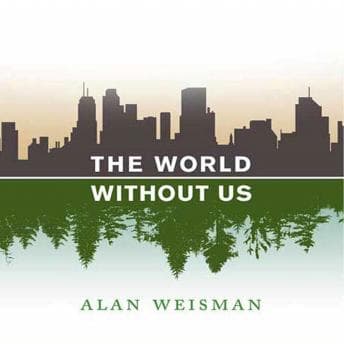

So here's the thing people keep saying about this book: it's depressing. And I get why they'd think that - the premise is literally "what happens when every human vanishes" - but I spent a Saturday night unable to sleep after a rough on-call rotation, and this book hit completely different at 1AM staring at my ceiling. It's not depressing. It's weirdly... peaceful? Like watching a time-lapse of nature reclaiming a parking lot. There's something almost meditative about imagining Lexington Avenue collapsing into an underground river because the steel columns supporting the street finally corrode after twenty years without maintenance crews.
TL;DR: Worth your commute, but maybe not at 6AM. This is the rare nonfiction audiobook where the concept carries you through 12+ hours, even when the narration doesn't always match the material's energy.
Debugging the Planet's Infrastructure (Without Us)
Weisman basically runs a thought experiment that any engineer would love: what happens when you remove the maintenance team from the most complex system ever built? Turns out, human civilization is basically a distributed system with zero fault tolerance. No graceful degradation, no failover. Pull the operators and everything cascades.
The best sections are the ones grounded in real places where humans already vanished. The Chernobyl chapters are fascinating - wolves and wild boar reclaiming the exclusion zone, trees cracking through concrete. The Białowieża Forest in Poland, one of the last old-growth forests in Europe, serves as a baseline for what "before humans" actually looked like. And the Korean DMZ as an accidental nature preserve? That section alone justifies the listen. There's something about watching nature quietly outlast human catastrophe that Watership Down taps into as well — that same undercurrent of resilience playing out across a landscape that doesn't care about us at all.
But Weisman also gets into the stuff that'll genuinely keep you up at night (speaking from experience). Plastic doesn't biodegrade - it just breaks into smaller and smaller pieces. Our radio waves will keep traveling outward, fragmented and fading, essentially forever. Bronze sculptures might outlast everything else we've built. There's something absurdly poetic about the idea that our most durable legacy might be a handful of statues and an ever-expanding sphere of old TV signals.
The science actually holds up. Weisman did his homework - the infrastructure decay timelines, the ecology, the materials science. It reads like someone interviewed a hundred specialists and then actually synthesized it into a coherent narrative instead of just dumping quotes. The ROI on this audiobook is solid for anyone who's ever wondered how long their apartment building would last without a super.
Adam Grupper: The Narrator Debate
Okay, here's where opinions split hard, and I'm going to be honest about where I land. Adam Grupper has this very measured, phlegmatic delivery - almost NPR documentary style. Objective. Steady. Some people call this "impeccable" and "sincere." Other people call it a sleep aid.
Both camps are right.
At 1x speed during my insomniac Saturday, Grupper's tone was perfect. Calm, authoritative, no unnecessary drama. But I tried picking this up on Monday morning's 6:12 Caltrain and - yeah, I lost about 20 minutes somewhere around the plastics chapter. His delivery doesn't have enough dynamic range to compete with a packed train car and half a night's sleep. There's a stiffness that creeps in during the more technical passages, like he's reading from a podium rather than telling you a story. He's not bad by any stretch, but he's not doing the heavy lifting that a narrator like (sorry, I have to say it) Ray Porter would bring to material like this.
I bumped it to 1.5x for the commute and that helped significantly. The slightly faster pace adds energy that the narration itself is missing. At 1.75x it gets a little too clipped for the scientific detail - you need to actually process the timelines and ecosystem explanations - so 1.5x is the sweet spot.
Who Gets the Most Out of This
Perfect for: dedicated listening sessions, long road trips, bedtime (seriously, Grupper's tone works great for winding down while still learning something). If you're into infrastructure, ecology, materials science, or just want the ultimate "what if" scenario played out rigorously - this is your book.
Skip for: early morning commutes unless you're a morning person (I am not). Also skip if you need narrative urgency or character-driven storytelling. This is a concept book, not a story. It wanders between topics the way a good documentary does, but if you want a tight through-line, you'll get restless.
Kevin actually listened to this one years ago and told me it was "fine." Reader, it is better than fine. It's the kind of book that rewires how you look at every building, bridge, and plastic bag for weeks afterward. I walked past a subway grate on Market Street yesterday and thought about those corroding steel columns.
Worth a Credit? Almost.
This is basically a Systems Design Interview but for planet Earth. The content is genuinely excellent - 4+ stars for the material alone. But Grupper's narration holds it back from being a must-listen audiobook specifically. If this were re-recorded with a narrator who brought more texture to the quieter chapters, it'd be an easy 5. As it stands, I'd say grab it on sale or through your library app. The book deserves your time; the audio production just doesn't quite earn the premium.








![Steve Jobs [unabridged audiobook] audiobook cover](/_next/image?url=https%3A%2F%2Fcovers.audiobooks.com%2Fimages%2Fcovers%2Ffull%2F9788499923406.jpg&w=1920&q=75)