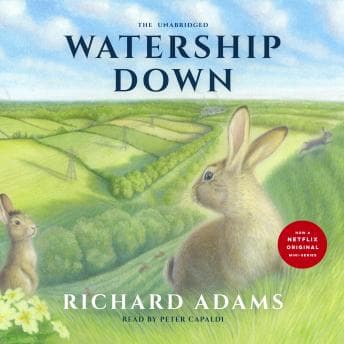

Look, I need to confess something. I've been putting off Watership Down for years. Years. Every time someone mentioned it, I'd nod and say 'Oh yeah, the rabbit book, it's on my list' while secretly thinking it was just a kids' story about cute bunnies. My D&D group finally staged an intervention. 'Tom,' they said, 'you literally read 40-hour LitRPG series about guys punching goblins, but you won't listen to one of the greatest fantasy epics ever written because it has rabbits?'
They had a point.
The World-Building That Puts Most Fantasy to Shame
Here's the thing about Watership Down that nobody warned me about: Richard Adams built an entire civilization. We're talking language (Lapine), mythology, folklore, social structures, military tactics - the works. This isn't 'animals talk and have adventures.' This is Sanderson-level world-building wrapped in fur and long ears.
The rabbit warren culture is so fully realized it's almost embarrassing how much I got invested in their politics. There's a warren that's basically a dystopian nightmare. There's another that's run like a military dictatorship. And our band of refugees from Sandleford? They're trying to build something new while carrying the weight of their destroyed home. If you stripped out the rabbit stuff and told me this was a grimdark fantasy about displaced peoples, I'd believe you.
And the mythology - oh man, the mythology. The stories of El-ahrairah (the rabbit folk hero) are woven throughout, and they function exactly like the in-world legends in the best epic fantasy. That same layered mythology approach is what makes Mythos: The Greek Myths Retold so compelling—the way ancient stories inform and echo through everything that comes after. They inform the culture, they parallel the main narrative, they add this incredible depth. I found myself as invested in the rabbit creation myth as I am in the Cosmere.
Peter Capaldi's Voice Lives in My Head Now
Steven Pacey walked so other narrators could run, but Peter Capaldi? He's sprinting right alongside him. That Scottish rasp has this quality - I don't know how to describe it - it's like being told a story by a very wise grandfather who also happens to be slightly terrifying when he wants to be.
He does over 20 distinct character voices. Twenty. And they're not just 'slightly different pitches.' Hazel sounds different from Bigwig who sounds different from Fiver who sounds different from General Woundwort (who sounds like the villain he absolutely is). The does have different voices from the bucks. The Efrafan rabbits sound different from the Watership Down rabbits. Genuinely impressive work.
But here's what really got me: Capaldi knows when to pull back. The descriptive passages of the English countryside? He goes soft and almost dreamy. Then a fox shows up and suddenly the tension ratchets up and you're white-knuckling your steering wheel on the highway. (Not that I'd know anything about that. I definitely didn't almost miss my exit during the Efrafa escape sequence.)
This Is Not a Children's Book
I need to say this clearly because I went in with wrong expectations: Watership Down is not a kids' story. I mean, yes, it's categorized that way sometimes, and yes, kids can read it. But there's violence here. Real violence. Rabbits die. Some deaths are quick and brutal, others are drawn out. The warren of the Shining Wires is genuinely horrifying in a way that stuck with me for days.
This is an allegory about freedom, survival, leadership, and what we owe each other. It's about refugees building a new home. That exploration of how communities fracture and rebuild under pressure is exactly what Blood of the Covenant wrestles with—different factions, different visions of what survival means. It's about the different ways societies can go wrong - through complacency, through tyranny, through denial. Heavy stuff, wrapped in an adventure story that absolutely rips.
At 17 and a half hours, it's a commitment. But honestly? It flew by. I listened instead of writing my thesis for an entire week. (Dr. Patel, if you're reading this, I was doing important cultural research.)
Would I Listen Again?
Already started my second listen. This time I'm paying closer attention to the Lapine language because apparently I'm the kind of person who learns fictional rabbit vocabulary now. My D&D group is thrilled. They keep suggesting rabbit-based campaign settings. I keep saying no. (I'm lying. I'm already working on it.)
Who Should Listen (And Who Should Skip)
If you're a fantasy reader who's been sleeping on this because 'it's about rabbits' - stop that. This is one of the greats. Capaldi's narration elevates already excellent source material into something genuinely special. Skip it if you need constant action or can't handle animal death - this one earns its emotional weight. But if you love deep world-building, layered mythology, and stakes that actually matter? The progression is satisfying, the world-building is chef's kiss.
Yes, it's 17 hours. Yes, it's worth it.