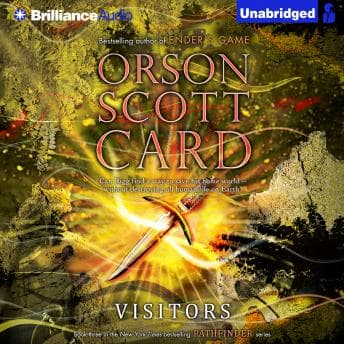

What do you do when a series you've loved goes full multiverse-brain in the finale?
I was deep into a coding session at 2 AM - thesis work, allegedly, though mostly I was debugging a procedural dungeon generator that kept spawning rooms inside other rooms - when I realized I'd been listening to Visitors for six hours straight. That's either proof of Card's grip on me or evidence that I'll do literally anything to avoid writing about Perlin noise functions. Probably both.
Here's the thing about the Pathfinder trilogy: it's Sanderson-level world-building wrapped in time travel mechanics that would make a physics professor weep. Rigg's ability to see the paths of people's pasts? *Chef's kiss*. The wallfolds? Genuinely clever sci-fi conceits. But by book three, Card is juggling so many timelines, alternate versions of characters, and causality loops that I found myself rewinding sections just to figure out which Rigg we were following.
When Your Campaign Gets Too Ambitious
You know that feeling when your D&D group starts a simple dungeon crawl and somehow ends up trying to prevent a multiversal collapse by session twelve? That's Visitors. The scope expands exponentially, and while I respect the ambition - Card is clearly having a blast with the temporal mechanics - the intimate character work from Pathfinder gets lost in the cosmic shuffle.
The pacing struggles because of this. Some listeners bounced hard, calling it "tediously complex," and I get it. There are stretches where you're processing exposition about timeline branches rather than experiencing story beats. It's the kind of book where you need dedicated listening time, not background audio while you're grinding in Baldur's Gate 3. Essentialism argues for this kind of focused attention, though I doubt Greg McKeown had temporal mechanics puzzles in mind.
But here's my contrarian take: if you're the kind of person who actually enjoys working through complex systems - who reads Sanderson's Ars Arcanum sections for fun - there's genuine satisfaction in watching Card's temporal puzzle pieces click together. The progression IS there. It's just buried under layers of "wait, which version of Param is this?"
Three Narrators, One Coherent World
Emily Rankin, Kirby Heyborne, and Stefan Rudnicki split the narration duties, and honestly? It works better than it has any right to. Rudnicki handles the more cosmic, exposition-heavy sections with the gravitas they need (his voice just *sounds* like someone who understands how time works). Heyborne brings warmth to the character moments. Rankin grounds the female perspectives.
I can't point to specific accent quirks or pronunciation issues because - and this is telling - none of them pulled me out of the story. In a book this complex, that's a minor miracle. The production is clean, the transitions between narrators are smooth, and nobody's phoning it in despite the 16+ hour runtime.
Who Should Strap In (And Who Should Eject)
If you haven't read Pathfinder and Ruins, absolutely do not start here. You'll be lost before the first hour ends. This is a finale that assumes you remember details from book one.
If you loved the first two books but felt the time travel was already pushing it? This might break you. The complexity doesn't decrease. Card doubles down.
But if you're like me - if you genuinely enjoy info-dumps, if you read wikis for fictional magic systems, if your idea of fun is mapping out causality chains - this is a satisfying conclusion. Not perfect. The emotional stakes get diluted when you're juggling multiple versions of every character. But the intellectual puzzle? It lands.
My D&D group would eat this up. We're the kind of people who argue about whether a Wish spell could create a stable time loop. Visitors is basically 16 hours of that argument, dramatized.
Worth the Thesis Procrastination?
I finished it. That's more than some listeners can say - I've seen the DNF reviews. And while Visitors isn't the strongest entry in the trilogy, it's a real ending, not a cop-out. Card commits to his temporal mechanics and follows them to their logical conclusions, even when those conclusions require flowcharts to track.
The narration is genuinely terrific. The story got too big for its own good. And I lost another week of thesis progress.
Dr. Patel is going to be so disappointed. Worth it.