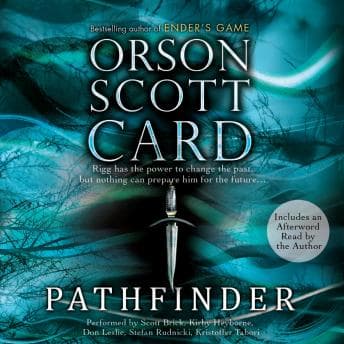

Seventeen hours and forty-four minutes. I need to talk about this number for a second. That is not a nap-time book. That is not a school-drop-off book. That is a full commitment, the kind of commitment I haven't made since I agreed to potty train Lucas. And honestly? The potty training had a more satisfying resolution.
I went into Pathfinder because my oldest, Emma, is starting to get into sci-fi (she watched a Star Wars movie at a friend's house and now everything is "the force this" and "lightsabers that") and I wanted to screen something we might eventually share. Orson Scott Card wrote Ender's Game, which I loved in college, so I figured this was safe territory. I had that same "safe bet" feeling going into Twilight years ago—familiar author territory, right? And it is - it's clean, it's smart, it's got a kid protagonist figuring out he's special. But here's what nobody warned me about: this book requires your FULL brain.
Seventeen Hours of Time Travel Logic Problems
Rigg can see the paths people have walked in the past. Like literal glowing trails showing where everyone has ever been. Which is a cool concept that Card then proceeds to layer with time manipulation, political intrigue, a mystery about Rigg's dead father, and - oh yeah - interstitial chapters set on a spaceship that seem to be from a completely different book. For the first few hours I kept thinking my Audible app had glitched and started playing something else.
The thing is, once you understand that those spaceship sections connect to Rigg's story (and it takes a while), the world-building is genuinely impressive. Card is doing something ambitious here - building a planet with multiple isolated civilizations separated by invisible walls, with a deep history that Rigg is slowly uncovering. It's the kind of puzzle-box storytelling that rewards attention.
And that's exactly the problem for someone who listens while separating two kids fighting over a Peppa Pig figurine.
I had to restart chapters. Multiple times. There's a stretch in the middle where Rigg and his friend Umbo are experimenting with how their time-manipulation powers work together, and it's basically a philosophical thought experiment narrated aloud. I paused to deal with Sophie's diaper situation, came back, and had absolutely no idea what was happening. This book did NOT survive 47 pauses. It barely survived 3. The Life We Bury had the opposite problem—so gripping I actually forgot to pause when Sophie started yelling about juice.
Five Narrators Walk Into a Recording Studio
So there are five narrators on this thing - Kirby Heyborne, Scott Brick, Stefan Rudnicki, Don Leslie, and Kristoffer Tabori. Five. For context, that's more narrators than I have children, and managing my children is already chaos. The idea is that each narrator handles different character perspectives, which sounds great on paper. And sometimes it works - the shifts between POVs are immediately clear because suddenly a different human is talking to you.
But the styles are SO different that it's jarring. The main narrator (Heyborne, who carries most of Rigg's sections) has this very even, measured delivery that - and I'm sorry to say this - can sound like he's reading a science textbook. Which is fine for the logic-heavy time travel sections, I guess? But when Rigg is supposed to be an emotional teenager discovering his father lied to him about everything, I wanted more... heat. More feeling. The other narrators bring different energy levels, which means the audiobook lurches between tones in a way that kept pulling me out of the story.
Scott Brick is solid as always (that man could narrate a grocery list and make it sound important), and Rudnicki brings gravitas to the sections he handles. But the overall effect is like listening to a podcast where the hosts keep switching without warning.
Who This Is Actually For (And It Might Not Be Me)
Here's where I landed after two and a half weeks with this book: Pathfinder is genuinely clever science fiction. Card knows how to build a world and populate it with kids who are smarter than the adults around them (very Ender's Game DNA here). The political maneuvering once Rigg reaches the city and discovers he might be royalty - that part I actually enjoyed during my car-sitting-in-the-garage sessions. There's a scene where Rigg essentially cons a banker using his path-seeing ability that made me grin.
But I felt distant from these characters the entire time. Rigg is competent and interesting but hard to love. His companion Umbo has more emotional range but gets sidelined. And the ending is very much a "book one of a series" situation - threads left dangling everywhere, which means another 17+ hours if I want answers.
If your kids are 10+ and into brainy sci-fi, this could be a great family listen - but only if you can all sit down and focus together (ha). If you're a multitasking mom hoping to squeeze this into stolen moments? You're going to struggle. I did.
The Car Is Running But I'm Not Going Inside Yet
Not groundbreaking, but sometimes you don't need groundbreaking - except this time I think I actually did need it to justify 17 hours. Card fans and young sci-fi readers will find a lot to chew on here. Me? I'm going back to something I can follow while making dinosaur-shaped chicken nuggets.