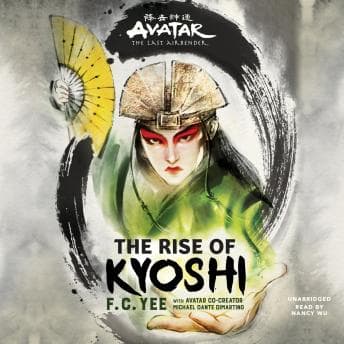

"I never asked to be the Avatar."
Somewhere around hour three, Nancy Wu delivers this line with such quiet devastation that I stopped grading entirely. Red pen hovering over a sophomore's questionable thesis about symbolism in The Great Gatsby, and I'm sitting there at 11:47 PM thinking about a fictional earthbender's identity crisis. This is why we still read the classics—and why, apparently, we now listen to their spiritual successors set in worlds where people throw rocks with their minds.
Let me be clear about something: I came to The Rise of Kyoshi as someone who watched exactly zero episodes of Avatar: The Last Airbender. My students have been horrified by this admission for years. "Mr. Williams, it's literally the greatest show ever made," they tell me, as if I haven't heard the same thing about Breaking Bad, The Wire, and whatever anime is trending this week. But F.C. Yee's novel doesn't require that homework. It stands alone—a bildungsroman wrapped in fantasy clothing, and honestly? The prose deserves to be savored.
What Hemingway Would've Said About Kyoshi
This reminds me of what Hemingway said about writing—show the thing, don't explain the thing. Yee understands this instinctively. Kyoshi's journey from overlooked servant girl to reluctant Avatar isn't told through exposition dumps. It's shown through her relationship with Rangi, through her fumbling attempts at bending, through moments of violence that feel genuinely raw rather than cartoonish.
The grief in this book caught me off guard. I was expecting young adult adventure—which, yes, it delivers—but the emotional weight here rivals what you'd find in literary fiction. Catch of the Day surprised me the same way: genre packaging that hides genuine emotional depth. Kyoshi loses people. She makes terrible choices. She joins outlaws because the legitimate power structures have failed her utterly. If you loved The Count of Monte Cristo for its patient exploration of justice and vengeance, this is its spiritual successor. Road explores that same slow-burn vengeance, though its apocalyptic setting trades magic for survival. Just with more elemental magic and fewer French prisons.
At fourteen and a half hours, this isn't a quick listen. I spread it across two weeks of lakefront walks with Denise (who kept asking why I looked so pensive), several late-night grading sessions, and one particularly long faculty meeting where Principal Martinez was explaining budget allocations. Worth pausing the faculty meeting for. (Sorry, not sorry.)
Nancy Wu Knows That Pause Is Punctuation
Wu's performance is interpretive in the best sense—she's not just reading words, she's making choices about who these characters are. Her Kyoshi starts uncertain, almost apologetic, and by the final hours has developed an edge that feels earned rather than performed. The evolution happens so gradually you don't notice until suddenly you're listening to a different person.
Now, I'll be honest: her old man voices take some adjustment. There's a particular elderly character whose voice initially made me wince—it borders on caricature. And her young children sound... well, like an adult doing a young child voice. My students would hate this. I love it. (Okay, I love most of it. The kid voice I could do without.)
But here's what matters: Wu differentiates. Her Irish lilt—or whatever the Avatar-universe equivalent is—for certain characters creates instant social distinction. You know immediately when Rangi speaks because there's this aristocratic precision that contrasts beautifully with Kyoshi's rougher edges. That's not just reading. That's performance art.
The Daofei Problem (And Why It Works)
The middle section drags slightly when Kyoshi joins the daofei—these shadow-dwelling outlaws who become her found family. Yee clearly loves this world-building, and I respect the commitment, but around hour eight I found myself wishing for a faster pace through some of the criminal underworld politics. It's necessary setup, but it's setup nonetheless.
That said, the payoff justifies the patience. When Kyoshi finally embraces what she is—not just the Avatar, but a particular kind of Avatar, one forged in poverty and injustice rather than privilege—the narrative earns its emotional climax. Yee is really saying something about how our origins shape our sense of justice, and it lands.
Who Should Walk This Path
If you're an Avatar fan, you've probably already listened. But if you're like me—a skeptic who wandered in from the literary fiction section—this works as a standalone origin story about power, identity, and the violence inherent in systems that claim to maintain peace. Parents should know there's genuine violence here, not sanitized for the YA label. Grief hits hard. Political machinations get murky.
Skip this if you need constant action. The pacing is deliberate, almost literary in its patience. I listened at 1.0x because Yee chose those words, and I chose to hear them properly. Your mileage may vary.
The Red Pen Stays Down
I finished The Rise of Kyoshi at 1:23 AM, that stack of ungraded essays still sitting there, and I didn't regret a single minute. Tomorrow's students would get their papers back late. Tonight, I was thinking about what it means to become someone you never expected to be—and how the stories we tell about heroes might be missing the point entirely.
My students were right. I should've started this journey years ago.
(Don't tell them I said that.)