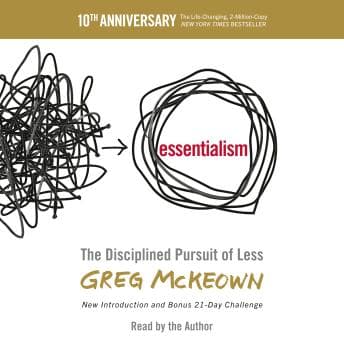

Okay, so here's the thing about self-help books: they're basically case studies in human behavior wrapped in a shiny promise. And as someone who spends her life analyzing why people do what they do, I find myself asking: why does Greg McKeown's Essentialism work when so many others don't?
I listened to this during my morning jogs through Cambridge—six hours spread across maybe two weeks of runs. And I'll be honest, somewhere around mile three on day four, I had one of those annoying epiphany moments where I realized I was listening to a book about doing less while simultaneously overcommitting to a half-marathon I don't actually want to run. (My therapist would have thoughts about this irony.)
The core premise here exhibits classic cognitive reframing. McKeown isn't selling productivity hacks or time management tricks. He's essentially arguing that most of us are operating from a psychological position of learned helplessness when it comes to our own choices. We say yes to everything because we've convinced ourselves we have to. This is exactly where Getting to Yes: How To Negotiate Agreement Without Giving In becomes useful—understanding negotiation principles helps you realize that saying no is itself a negotiation, not a rejection. The research actually shows this is a real phenomenon—we overestimate the consequences of saying no and underestimate the cost of saying yes. McKeown gets this. He understands human nature in a way that a lot of business writers frankly don't.
Now, about the narration. McKeown reads his own work, and look—author-narrated audiobooks are a gamble. Sometimes you get someone who wrote a brilliant book but sounds like they're reading a grocery list. Not the case here. His delivery is clear, measured, maybe even a little too measured at times? There's an almost meditative quality to his pacing that works for the content but might feel slow if you're used to more dynamic narrators. I bumped it up to 1.25x during my runs and that felt right.
What makes this book compelling is the framework itself. McKeown presents essentialism as a systematic discipline—not a one-time decluttering session but a complete operating system for decision-making. It requires the kind of sustained mental discipline that Power of Concentration explores, though I'll admit that book takes a more old-school approach to focus. He uses this visual of the closet that needs regular editing, and psychologically, this tracks. Behavior change research consistently shows that sustainable change requires ongoing practice, not single interventions. He's not promising a quick fix. He's describing a lifestyle shift.
But here's where I got a little annoyed. Some of his examples? Ugh. He references Rosa Parks, Nelson Mandela, and—somewhat awkwardly—the Book of Mormon in ways that feel like he's reaching for gravitas. The protagonist of his narrative (which is basically "overworked professional finds meaning") doesn't need these heavy historical comparisons. It's a fascinating case study in how authors sometimes undermine their own credibility by overreaching. The simpler examples from his consulting work at Apple and Google actually land better because they feel earned.
The 21-day challenge PDF that comes with the audiobook is a nice touch. Practical, actionable, gives you something to do with all this theory. Though I'll admit I downloaded it and then—in a move that would make McKeown weep—added it to my pile of "things I'll get to eventually." We contain multitudes.
Who Should Listen (And Who Should Skip)
If you're a busy professional who feels like you're running on a hamster wheel, if you've ever looked at your calendar and felt genuine despair, if you suspect that being busy isn't the same as being productive—this is for you. The verbal presentation makes it super easy to absorb during commutes or workouts. It's the kind of book you might want to revisit every year or so, just to recalibrate.
Who should skip it? If you've already read a lot in the minimalism/essentialism space, some of this will feel familiar. If you need high-energy, story-driven content to stay engaged, the pacing might lose you. And if you're the kind of person who gets distracted by slightly clunky historical references, you'll notice them. I noticed them. I'm still a little annoyed about the Rosa Parks thing.
The production quality is clean—no weird audio artifacts, no background noise, nothing to pull you out of the listening experience. Professional throughout.
Final Analysis
This is a book about saying no, and ironically, it made me say yes to some uncomfortable self-reflection. I found myself mentally cataloging all the committees I've joined, the papers I've agreed to review, the dinner invitations I've accepted out of obligation rather than genuine interest. McKeown would probably tell me to ruthlessly eliminate about 80% of my current commitments.
He's probably right. (Don't tell my department chair I said that.)