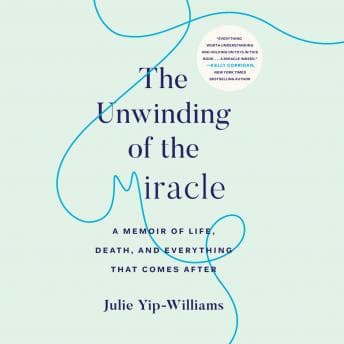

"I did not survive being blinded in Vietnam, survive my grandmother's attempt to have me euthanized, survive refugee boats and oceans and starting over in America — just to die at thirty-seven."
That's not an exact quote. But it's the essence of what hit me somewhere around hour two, sitting alone on my back porch at midnight with Ranger's head on my boot, and I had to pause the audio. Just sat there for a minute. Because that kind of defiance — that white-hot refusal to accept what's coming — I've seen it in soldiers. I've seen it in men and women who looked at impossible odds and said no. Julie Yip-Williams had that same fire, and she aimed every bit of it at a disease that didn't care how fierce she was.
Let me cut to the chase: this book wrecked me. And I don't say that lightly.
A Life That Earned Every Page
Julie's story doesn't start with cancer. That's what makes this different from every other terminal illness memoir sitting on your shelf. It starts in Vietnam with a blind infant whose own grandmother arranged for a herbalist to essentially poison her — mercy killing, as the family saw it. The herbalist, for whatever reason, used a diluted dose. Julie lived. Then came the refugee boat with three hundred people crammed together, Hong Kong, America, partial sight restored by a UCLA surgeon, Harvard Law, marriage, two daughters. By the time the colon cancer diagnosis lands at thirty-seven, you're not reading about a dying woman. You're reading about someone who has been fighting to exist since the day she was born.
And she writes like a fighter. Not flowery, not self-pitying. She's angry sometimes — genuinely, bracingly angry about the unfairness of it — and then two pages later she's writing about tennis or fortune-tellers with this sharp, almost wicked humor. The range is what gets you. One chapter she's dissecting the immigrant experience with the precision of the lawyer she was, the next she's writing letters to her daughters that... look, I've written letters like that. Different circumstances, different war, but the same desperate need to leave something behind for the people who matter. That part I understood in my bones.
Emily Woo Zeller Did Right By This Woman
Zeller carries this book. She has to — she's voicing a dead woman's words, which is a responsibility that could go wrong in a hundred ways. Too much emotion and it becomes performative grief. Too little and you lose the fire that made Julie's writing worth reading. Zeller threads that needle. When Julie writes about her fury at cancer, Zeller's delivery has this controlled heat to it — not melodramatic, just steady and burning. When the passages turn to Julie's daughters, the voice softens but never breaks into something weepy. She trusts the words to do the work.
Joshua Williams reads the afterword and epilogue — Julie's husband finishing the story after she couldn't. That transition is a gut punch on its own. His sections are quieter, more measured, the voice of someone still living inside the loss. Having that second narrator wasn't a gimmick. It was the only honest way to end this book.
I listened at my usual 1.25x for the first few hours, then dropped to 1x. Some books earn that slower speed. This was one of them.
Where It Sits With Me Now
I've been thinking about why this book hit so differently than other memoirs about dying. Part of it is Julie's refusal to be inspirational on command. She doesn't wrap things up neatly. She writes about jealousy — raw, honest jealousy of healthy people who get to watch their kids grow up. She writes about the absurdity of researching clinical trials while also planning school pickups. She writes about marriage under the pressure of terminal illness without pretending it's all hand-holding and meaningful glances. It's messy. It's real.
The other part is the immigrant story layered underneath everything. Julie's survival of Vietnam, the refugee journey, building a life in America — that context turns the cancer diagnosis into something almost mythic. Not because she was special (though she was), but because the universe kept testing this woman and she kept showing up, right until she physically couldn't.
I've read a lot of books about death. Comes with the territory of my career. But this one isn't really about death. It's about the audacity of living fully when you know exactly how little time you have left.
Worth your time? Here's the debrief: if you've ever written a letter to someone you love because you weren't sure you'd come home — or if you've ever just wondered what you'd say with the clock running out — this one's for you. Skip it if you're not in a place to handle raw honesty about mortality. There's no cushioning here. I'll say this too — if the idea of time running out is something you want to sit with rather than run from, Arnold Bennett's How to Live on 24 Hours a Day approaches that same urgency from a completely different angle, and it's worth an hour of your life.
Ranger approved this one. He also licked my hand during the hard parts, which is about the highest rating he gives.