
This book broke me at 7:14 AM on a Tuesday, standing room only on the Caltrain, gripping a pole with one hand while trying not to visibly react to Rin making the worst possible decision for the fifteenth time.
TL;DR: Worth your commute. All 24 hours of it. But this is not a happy ending kind of series, and the final act will leave you staring at your reflection in the train window wondering what you just experienced.
Rin's Descent Is the Point, and It Hurts
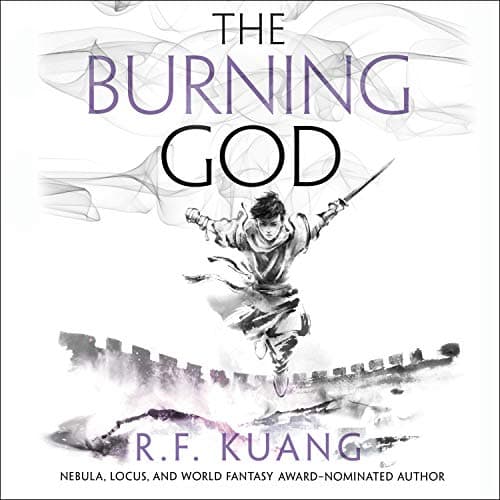
Some listeners bounced off this one because it's exhausting. I get it. At nearly 24 hours, The Burning God is a commitment - this took me about 8 commutes at 1.5x, and by the end I was genuinely dreading what Rin would do next. Not because the story was bad, but because Kuang does this ruthless thing where she gives you Rin's internal logic, makes it almost convincing, and then shows you the body count. You're watching someone radicalize in real time while understanding every step of the reasoning. It's deeply uncomfortable.
The thing people complain about - feeling detached and exhausted - is honestly kind of the point? Rin's arc across all three books is basically a study in how revolutionary fervor eats its own. She goes from desperate orphan to war hero to something much harder to root for. By the midpoint of this book, when she's consolidating power in the south and the Phoenix is whispering louder than ever, I stopped asking "will she win" and started asking "should she?"
Kuang's background in Chinese studies is doing serious heavy lifting here. The parallels to Mao's rise - the populist rhetoric, the cult of personality, the purges of former allies when they become inconvenient - aren't subtle, and they don't need to be. This is basically the Long March but with shamanic fire gods, and that combination shouldn't work as well as it does.
Emily Woo Zeller Carries 24 Hours on Her Back
I'll be honest, when I started The Poppy War trilogy I was skeptical about a single narrator handling this much material across three books. But Zeller earns every minute. Her Rin in this final volume is noticeably different from Book 1's Rin - there's this hardened, slightly manic edge to the delivery that tracks perfectly with where the character is. When Rin is being charismatic to the southern provinces, you can hear the manipulation underneath the inspiration. When she's losing it, Zeller doesn't go full scenery-chewing crazy - she goes quiet and certain, which is way scarier.
The pronunciation is flawless throughout, which matters more than people realize in a book this steeped in Chinese-inspired names and places. Nothing pulls you out of a fantasy audiobook faster than a narrator stumbling over proper nouns for 24 hours. Zeller never does.
My one note: around the 16-18 hour mark (roughly - I'm estimating based on commute count), there's a stretch of political maneuvering and coalition building that felt like it needed a slightly faster pace. The narration stays at the same intensity level as the battle scenes, which made those chapters feel heavier than they probably read on page. Not a dealbreaker, but I bumped to 1.75x for that section and switched back when things got dire again.
Who This Is (and Isn't) For
Perfect for: long commutes, road trips, dedicated listening sessions. This demands attention. I tried listening while debugging a flaky microservice once and had to rewind 20 minutes because I'd completely zoned into the code and missed a major betrayal.
Skip for: background listening, bedtime (unless you want nightmares about shamanic warfare), or if you haven't read books 1 and 2. Do not start here. Seriously.
If you loved grimdark fantasy but wished it had something to say beyond "war is bad, look at this disembowelment" - this is your series. Kuang actually interrogates power, colonialism, and what happens when the person fighting oppression becomes the oppressor. It's fantasy with a thesis statement, and the thesis has teeth. The closest I've come to that same sense of fiction with genuine intellectual weight was Ringworld Engineers, though Kuang's emotional brutality hits on a completely different register.
If you DNF'd book 2 because you were tired of Rin's choices, book 3 will not change your mind. She doubles down. Repeatedly.
The ROI on 24 Hours of Your Life
The ROI on this audiobook is high if you're invested in the trilogy - it's a genuine conclusion, not a setup for more books, and the ending is the kind of brutal, earned gut-punch that I was still thinking about three days later while Kevin tried to talk to me about dinner plans. (Sorry, Kevin. I was processing literary devastation.)
I finished this series feeling like I'd been through something. Not entertained - changed. That's rare for fantasy, and it's worth the commitment. Eight commutes. No regrets. Okay, maybe a few emotional scars.