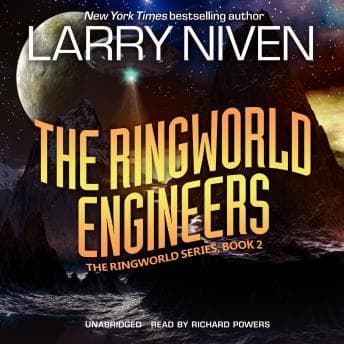

Look, I need to complain about something before we get started. Twenty years. Larry Niven made us wait twenty years in-universe between Ringworld and this sequel, and Louis Wu spent most of that time as a wirehead addict. The man who discovered one of science fiction's most audacious megastructures—a ring around a star, for crying out loud—reduced to chasing electrical pleasure straight to his brain. It's almost insulting. Almost.
But here's the thing Niven understands that most sequel writers don't: characters don't freeze in amber between books. People change. People fall apart. And sometimes the only thing that drags them back is getting kidnapped by a three-legged alien with a cowardice complex.
The Return Nobody Asked For (But Everyone Needed)
I finished this one during a particularly brutal week of grading sophomore essays on The Great Gatsby. There's something darkly appropriate about escaping papers full of "Gatsby was really rich" by listening to Louis Wu grapple with addiction, mortality, and the impending destruction of an artificial world that makes our planet look like a marble. The scale of Niven's imagination is genuinely humbling—and I say this as someone who teaches Faulkner's Yoknapatawpha County like it's a real place.
The premise is beautifully simple: the Ringworld is falling apart. The structure that seemed impossibly stable in the first book? Turns out maintaining something one million miles wide requires actual maintenance. Who knew? Louis, Speaker-to-Animals (now called Chmeee, which I kept mishearing as "Jimmy" during my late-night grading sessions), and the Hindmost—a Puppeteer who's essentially the universe's most technologically advanced coward—have to find the control center before everything crashes into the sun.
Richard Powers handles the narration with quiet competence. He's not doing theatrical voices or dramatic pauses for effect. What he does well is differentiate the characters through tone—the Puppeteers' calculating nervousness, the Kzin's barely-restrained aggression, Louis's world-weary resignation. It's not flashy work, but it's honest work. The kind of narration that gets out of the way and lets Niven's ideas breathe.
Hard Science Fiction That Actually Earns the Label
This reminds me of what Hemingway said about writing—that the dignity of movement of an iceberg is due to only one-eighth of it being above water. Niven's worldbuilding works the same way. You're getting maybe ten percent of what he's calculated about orbital mechanics, shadow squares, and the engineering tolerances of a structure that could hold a thousand Earths. The rest is implied, structural, holding everything up from underneath. Trial works the same way—Kafka's bureaucratic nightmare has its own invisible architecture that you only glimpse through K.'s confusion.
The prose deserves to be savored. At 1.0x speed (yes, I'm that person), you catch the little details—how the Ringworld's rim walls are high enough to hold in atmosphere, how the shadow squares create artificial night, how the entire structure is essentially a ribbon of land wrapped around emptiness. My students would hate this. They'd call it "too much science stuff." I love it.
But I'll be honest: some of the plot mechanics feel contrived. Characters make decisions that serve the story rather than logic. There's a fair bit of "we need to go here now because the author says so" rather than organic motivation. And the character development, while present, sometimes takes a backseat to the engineering puzzles. Niven is more interested in how things work than how people feel about how things work.
Who Should Listen (And Who Should Probably Grade Papers Instead)
If you loved the first Ringworld, this is its spiritual successor—same sense of wonder, same commitment to plausible impossibilities, same Louis Wu trying to figure out how to survive something way bigger than himself. Some listeners apparently consider this their favorite in the series, and I can see why. It's more focused than the original, more urgent.
Skip this if you need deep character psychology or action-packed pacing. This is a book for people who read about a million-mile-wide ring and think "but how would that actually work?" It's for the curious, the patient, the people who don't mind spending thirteen hours with ideas as much as characters. Where Angels Fear to Tread is the opposite—Forster cares far more about what people feel than how anything works, which is probably why I couldn't get through it.
Principal Martinez, if you're reading this: I was definitely paying attention during your budget presentation last Tuesday. (I wasn't. I was on hour seven, learning about Ringworld meteor defense systems. Worth it.)
Worth Pausing the Faculty Meeting For
At thirteen hours, this is a commitment. Powers' narration won't blow you away, but it won't distract you either. The story has its contrivances, its pacing lulls, its moments where you wish Louis would just feel something more deeply. But the core experience—exploring something genuinely alien, genuinely massive, genuinely thought through—that's still here. That's still worth your time.
This is why we still read the classics of science fiction. Not because they're perfect, but because they're ambitious in ways that smaller books can't afford to be. Niven built something impossible and then spent a whole novel figuring out how to keep it from falling down. That's not just engineering. That's art.