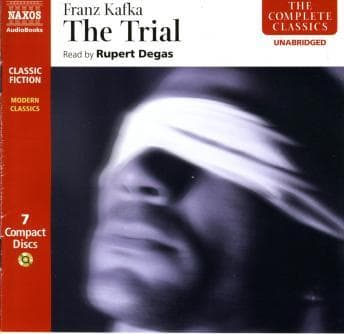

"Someone must have slandered Josef K., for one morning, without having done anything wrong, he was arrested."
That opening line. I've taught it probably fifty times, written about it on my podcast, and still—hearing Rupert Degas deliver it while I was walking the lakefront at 6 AM—it hit differently. There's something about Kafka in your ears, the fog rolling off Lake Michigan, that makes you feel like you're being watched. Which, I suppose, is the point.
The Voice That Gets Kafka's Absurdity
Look, narrating Kafka is a trap. Go too dramatic and you miss the deadpan horror. Too flat and you lose the reader entirely. Degas walks this line with what I can only describe as controlled unease. His Josef K. isn't hysterical—he's bewildered in a very specific, almost polite way. The kind of bewilderment you feel when someone at the DMV tells you your form is wrong but won't say which part.
What really works is how Degas handles the bureaucrats. Each court official, each lawyer, each bizarre functionary gets this slightly different shade of institutional indifference. The guards who arrest K. in his bedroom? They sound bored. Not menacing—bored. And that's way more terrifying, honestly. Because menace you can fight. Boredom just processes you.
I've seen some criticism that Degas can be too detached, and I get that. There were moments—especially in the middle sections with the painter Titorelli—where I wanted a bit more heat. But then I think about what Kafka's actually doing here, and the detachment starts to feel intentional. Josef K. is becoming numb to his own nightmare. Why shouldn't the narration reflect that?
Where the Prose Demands You Slow Down
My students think I'm ancient for listening at 1.0x speed. They're not entirely wrong. But Kafka at 1.5x? Absolutely not. The prose is too dense, too layered with meaning that only reveals itself if you let the sentences breathe.
There's a section in the cathedral—you'll know it when you get there—where the prison chaplain tells K. the parable of the doorkeeper. It's maybe ten minutes of narration. Degas slows down here, lets the parable unspool like a dream you can't quite wake from. I was supposed to be grading sophomore essays on The Great Gatsby. Instead I was standing in my kitchen, coffee getting cold, completely frozen. My students would hate this. I love it.
The pacing does drag in spots. Some of the legal discussions in the middle feel endless—though that's partly Kafka's point, isn't it? The law is designed to exhaust you. Still, around hour four, I found my attention wandering during a particularly dense conversation about court procedures. Came back to it the next morning and it clicked better.
Why We Still Read This a Century Later
Here's the thing about teaching high school for twenty years: you watch bureaucracy eat people alive. Students get labeled, sorted, processed through systems that nobody fully understands and nobody can change. I had a kid last year—brilliant kid, wrote the best essay on Beloved I've ever read—who nearly didn't graduate because of a paperwork error from freshman year. Nobody knew how to fix it. Everyone pointed to someone else.
That's The Trial. That's what Kafka understood before any of us were born.
This isn't just a story about a guy who gets arrested. It's about how systems strip away your humanity while insisting they're following the rules. The rules just happen to be incomprehensible, contradictory, and designed by people who left the building decades ago. (Principal Martinez, if you're reading this—I'm still not over the new attendance policy.)
Degas captures this beautifully. There's a weariness in his Josef K. by the end that feels earned. Not defeated exactly, but... resigned? Like he's finally understood that understanding was never the point.
Worth Pausing the Faculty Meeting For
If you've never read Kafka, this is a solid entry point—more accessible than people think, honestly. The Orson Welles film from '62 is worth watching afterward (Anthony Perkins is perfectly cast as K.), but the audiobook gives you something the movie can't: Kafka's actual sentences, which are these long, winding, bureaucratic nightmares that somehow feel completely natural.
If you loved The Stranger by Camus or you're into existentialist fiction generally, this is essential. Though if you're looking for existential dread wrapped in a dystopian system, Divergent explores similar themes of being processed and labeled by forces beyond your control. If you want something light for your commute? Maybe try something else. This is 8+ hours of mounting dread and philosophical weight.
But if you're ready for it—really ready to sit with the discomfort—Degas delivers. Not flashy, not dramatic, just steady and measured and deeply unsettling in exactly the right ways.
Denise asked me what I was listening to last week. I tried to explain and she said, "That sounds exhausting." She's not wrong. But some exhaustion is worth it.