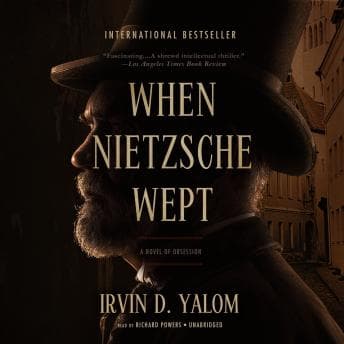

Denise and I had a deal this past weekend: she'd handle the grocery run, I'd handle the lakefront walk alone. Two hours, just me and Lake Michigan and whatever I was listening to. I'd just started When Nietzsche Wept the night before, and by the time I hit the turnaround point near the Shedd Aquarium, I'd completely forgotten I was supposed to be exercising. I was just standing there, probably looking unhinged, while Josef Breuer and Friedrich Nietzsche argued about whether a physician has any business treating a man who refuses to admit he's a patient.
That argument, by the way, is the entire book in miniature. And Yalom knows it.
What Yalom Is Actually Doing Here (And It's Sneaky)
Let's talk about what this novel is really saying, because on the surface it sounds like a historical curiosity - what if Nietzsche had been treated by Breuer, who would go on to co-develop psychoanalysis with Freud? Cute premise. But Yalom, who spent decades as a practicing psychiatrist before writing this, isn't interested in cute. He's interested in the question that every therapist eventually has to face: who heals the healer?
Breuer is the one who ostensibly has his life together. Successful practice, devoted wife, the intellectual friendship of a young Sigmund Freud. And yet he's consumed by an obsession with a former patient - Anna O., the real historical case that helped birth psychoanalysis - that he cannot shake and cannot admit. Nietzsche, meanwhile, is physically wrecked (the migraines in this book are described with a specificity that made me wince), philosophically isolated, and on the edge of something very dark. They're supposed to be doctor and patient. They end up being mirrors.
This is why we still read the classics, and why Yalom understood that a novel - not a biography, not a philosophy text - was the right form for this material. The fiction gives him permission to put Nietzsche on a couch and ask: what would it take for the man who declared God dead and championed the will to power to admit that he needed help? The answer is uncomfortable and, honestly, pretty moving.
My students would hate this. I love it. It's exactly the kind of book that rewards you for bringing something to it - some Nietzsche, some Breuer, some Freud - while also working on you if you bring nothing but patience.
Richard Powers and the Problem of Playing Philosophers
I want to be careful here because the research I'm working with on the narration is thinner than I'd like. What I can tell you from 15+ hours of listening: Powers earns his keep, but not in the flashy way.
This is not a performance that announces itself. There's no moment where you think, oh, impressive accent work or clever vocal distinction between characters. What Powers does is quieter and, I'd argue, harder. He understands that a novel built almost entirely on dialogue between two extraordinarily intelligent men requires him to get out of the way of the words while still making you feel the weight of them. The philosophical sparring sessions - and there are several that run long, as philosophical sparring sessions tend to do - never feel like lectures. They feel like arguments. There's a difference.
The narrator understands that pause is punctuation. In a book where Breuer is learning, in real time, to sit with silence as a therapeutic tool, Powers uses silence the same way. It's the kind of choice that probably goes unnoticed, which means it's working.
My one honest caveat: at 15 hours and 27 minutes, this is a commitment, and the pacing in the middle third - when Yalom is doing the heaviest lifting with Nietzsche's philosophy - asks something of you. This is focused listening. This is not lakefront-jogging listening. This is sitting-down-with-intention listening.
Who Should Walk Into This Coffeehouse (And Who Should Leave)
If you've ever taught Thus Spoke Zarathustra to a room of seventeen-year-olds who were absolutely not reading it, this book will feel like a small revenge. Yalom makes Nietzsche's ideas land in ways that a philosophy survey course rarely manages, because he embeds them in human need rather than abstract argument.
If you loved The Paris Wife or Loving Frank - those historical novels where the premise is essentially what if we imagined the private life behind the famous name - this is its philosophical older sibling. Less romantic, more rigorous, equally absorbing. I'd put Comstock Lode in a similar category of historical fiction that earns its length by trusting readers to meet the material halfway.
If you want plot momentum and forward propulsion: wrong room. This book moves the way therapy moves, which is to say it circles, it doubles back, it makes you think you've resolved something and then opens it back up. Some people find that frustrating. I found it honest.
Assigned Reading (For Once, I Mean That)
I've spent twenty years telling teenagers that great literature asks you to examine your own life while you're examining someone else's. When Nietzsche Wept does exactly that, and it does it through a premise so specific - Vienna, 1882, a philosopher and a physician, a talking cure that doesn't exist yet - that it somehow becomes universal. Yalom the psychiatrist and Yalom the novelist are working together here, and the result is a book that feels like it was written by someone who actually understands why people suffer and why they resist being helped.
Worth every minute of that lakefront standstill. Denise was less impressed when I came home having clearly not exercised.