
"The year is 2041, and love has gone contactless."
That line hit me somewhere around hour 3, packed into a BART train because Caltrain was down again, and I had to stop and just... sit with it. Emily Woo Zeller's delivery in that story—'Contactless Love'—is genuinely wrenching. The kind of performance where you forget you're listening to an audiobook and start feeling like you're eavesdropping on someone's actual heartbreak.
Bottom Line: This is basically Black Mirror but with actual technical depth and a techno-optimist who keeps pulling you back from the nihilism cliff. Worth your commute, but demands your attention.
The Hybrid That Actually Works
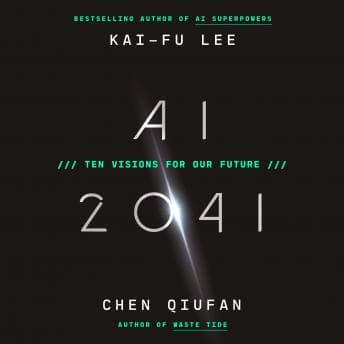
Here's the thing about AI 2041 that I wasn't expecting: it's not trying to be one thing. Kai-Fu Lee (former Google China president, the guy who literally built AI systems at scale) teams up with Chen Qiufan (award-winning sci-fi writer) to create this format where you get a fictional story, then Lee jumps in with "okay, here's why this isn't actually that far-fetched."
And unlike most business books that could've been blog posts? This one earns its 18 hours.
The stories span the globe—Sri Lanka, Munich, Tokyo, San Francisco—and each tackles a different AI application: autonomous vehicles, deep learning in insurance, mixed reality, the whole spectrum. The ROI on this audiobook is genuinely high if you want to understand AI beyond "ChatGPT is neat" without slogging through academic papers.
Seven Narrators, One Surprisingly Cohesive Listen
Okay, so here's where opinions diverge hard. Seven narrators. Seven. For ten stories plus commentary.
Some people found this distracting—I get it. The constant voice switching can feel like your podcast app is glitching. But honestly? After the first two stories, my brain adjusted. Fajer Al-Kaisi's pacing in 'The Holy Driver' (about an autonomous vehicle driver in Sri Lanka) creates this tension that a single narrator might've smoothed over. The global settings actually benefit from having narrators who can shift the cultural context.
The production is clean—no weird audio artifacts or volume inconsistencies that plague some multi-narrator projects. But if you're the type who needs one voice to settle into? Fair warning. This isn't that.
When the Technical Analysis Actually Delivers
This is where my distributed systems brain got happy. Lee's commentary sections don't just handwave at "AI will change everything." He breaks down specific technologies—federated learning, GANs, reinforcement learning—and explains why Chen's fictional applications are technically plausible within a 20-year window.
I finished this before ChatGPT went mainstream, and rereading my notes now is kind of eerie. Lee was already talking about large language models and their implications back in 2021 when this came out. The man saw it coming. That kind of prescient analysis is rare—though I found a different flavor of forward-thinking leadership in Dare to Lead, which focuses more on organizational courage than tech predictions.
The weakest stories are the ones that lean too hard on plot mechanics rather than character—there's one involving autonomous weapons that felt a bit goofy, like it was trying too hard to be a thriller. But even those have commentary sections that make them worth the time.
Best at 1.5x on a Focused Commute (Not Your 6AM Zombie Train)
I'll be honest—this isn't a 6AM zombie train book. The story-then-analysis structure means you actually need to track what's happening. I tried listening while debugging a particularly nasty race condition and retained exactly nothing.
But for a dedicated commute where you're awake and engaged? This is exactly the kind of book that makes train time feel productive. I finished it over about 12 commutes, and each segment gave me something to think about for the rest of the day.
Speed recommendation: I did 1.5x for the stories, dropped to 1.25x for Lee's technical breakdowns. The fiction flows well sped up, but you'll want to actually absorb the analysis.
Who Should Queue This Up (And Who Should Pass)
If you work in tech and want to understand where AI is actually heading (not the hype cycle version), this is worth your credit. If you're a sci-fi reader who's tired of AI stories written by people who clearly don't understand the technology? Same.
Skip it if you want pure fiction or pure business content. The hybrid format is the whole point, and if that sounds annoying rather than interesting, you'll be frustrated by hour 5.
Worth the 18-Hour Investment
Three years post-publication, this book has aged remarkably well. Some predictions already look conservative. That's... kind of terrifying, actually, but also exactly why it's worth the 18 hours. I came away with a framework for thinking about AI development that's more useful than anything I've gotten from Twitter threads or podcast hot takes.
Emily Woo Zeller's work on 'Contactless Love' alone is worth the price of admission. The rest is bonus.