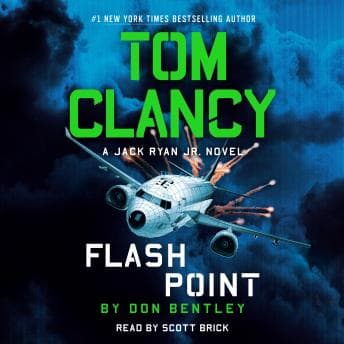

Look, I'll be honest - I started this one expecting the usual Jack Ryan Jr. formula. Competent hero, geopolitical crisis, explosions, wrap it up with a bow. And yes, Flash Point delivers all of that. But what caught me off guard was how much Don Bentley leans into the psychological cost of leadership when everything falls apart.
I was halfway through a morning jog through Cambridge when the Campus got hit with that crippling attack, and I actually stopped running. Just stood there on the path like an idiot while joggers went around me. Because here's the thing - Jack isn't just fighting bad guys in this one. He's watching his support system crumble and having to become the leader when he's barely processing his own trauma. The protagonist exhibits classic crisis leadership patterns, and Bentley clearly did his homework on how people actually respond when the structure they depend on vanishes.
When the Chess Pieces Start Moving
The South China Sea setup is pretty standard techno-thriller fare - midair collision, rising tensions, Taiwan under threat. We've seen this before. But Jack isn't operating from a position of strength here. He's scrambling. The Campus is in shambles, the American government is being systematically paralyzed, and Jack's running on fumes and instinct.
Bentley's background as an Apache pilot and FBI agent shows. The military details feel authentic without becoming a Wikipedia dump (my therapist would have thoughts about my tolerance for jargon, but that's another conversation). The pacing works - mostly. There are stretches of internal monologue that slow things down, and I found myself asking: why does Jack really need to process his feelings right now when there's a conspiracy to unravel? But honestly, that's also what makes him feel human rather than an action-figure cutout.
The conspiracy itself unfolds in layers. I won't spoil it, but the best thrillers make you feel smart for figuring things out just before the protagonist does. Memoirs of Sherlock Holmes operates on that same principle—you're racing alongside the detective, piecing together clues just a beat behind his revelations. Flash Point hits that sweet spot about 70% of the time. The other 30% I was either ahead of Jack (frustrating) or completely blindsided (satisfying).
Scott Brick Knows His Way Around the Clancy-Verse
I couldn't find much about his personal approach to this specific book, but based on eleven hours with him in my ears - the man knows how to handle this material. His pacing is deliberate, which some listeners apparently find slow. I get it. But for a plot this intricate, with this many moving pieces, I actually appreciated not feeling rushed.
His character voices are distinct without being cartoonish. The antagonists sound appropriately menacing, Jack sounds appropriately stressed, and the supporting cast each get their own vocal texture. Where Brick really shines is in the tense moments - there's this controlled urgency in his delivery that made my heart rate spike during action sequences. Edge of seat stuff, as one listener put it.
The criticism about feminine voice transitions? Yeah, I noticed it a couple times. It's not egregious, but it's there. Minor gripe in an otherwise solid performance.
The Psychology of Reluctant Leadership
This is a fascinating case study in what happens when someone who's always been part of a team suddenly has to BE the team. Jack's arc here isn't about becoming a better fighter or a smarter analyst. It's about accepting that leadership means making impossible calls with incomplete information while people you care about are in danger.
Psychologically, this tracks. Crisis leadership research shows that the most effective leaders in chaotic situations are the ones who can tolerate ambiguity while still acting decisively. Jack struggles with this - beautifully, I'd argue. He second-guesses himself. He grieves. He keeps going anyway.
Is there some soap opera-ish character development? Sure. A few moments felt a bit too sentimental for my taste. But I'd rather have a thriller that tries to give its characters emotional depth and occasionally overshoots than one that treats them as interchangeable action figures.
Who's This For (And Who Should Skip It)
If you're a Tom Clancy series devotee, this is solid continuation. If you like your geopolitical thrillers with authentic military detail and a protagonist who actually feels the weight of what he's doing, Flash Point delivers. Skip it if you hate slow pacing or get impatient with internal monologue during action sequences - or maybe just bump it up to 1.25x speed. The production quality is clean, Brick's narration can handle the acceleration, and you'll shave a couple hours off.
The Cost of Every Operation
Would I listen again? Probably not - I'm not a big re-listener for thrillers. But the ending sets up future installments without feeling like a cliffhanger. "Every operation has a cost," the tagline says. By the end, you feel that cost. And that's what separates a good thriller from a forgettable one.