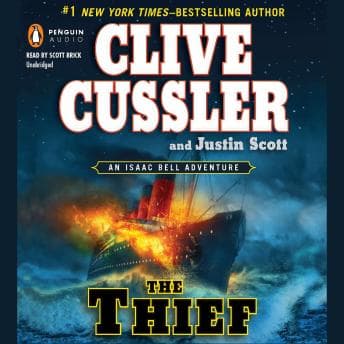

Isaac Bell is a fascinating case study in wish fulfillment.
I was chopping onions for a dal that would take three hours to cook properly when I started this, and by the time I'd finished prep, I'd already clocked Bell's psychology: he's the Edwardian-era detective who's always the smartest, fastest, most capable man in any room. The kind of protagonist who makes you ask—is this compelling characterization or just competence porn? After ten hours with Scott Brick in my ears, I've decided it's both. And I'm not mad about it.
The Mauretania Problem (Or: Why Cussler Understands Pacing)
The opening aboard the ocean liner Mauretania does something clever. Cussler and Scott don't waste time with throat-clearing exposition. We're immediately in motion—European scientists, shadowy abductors, Bell intervening with that particular brand of early-twentieth-century heroism that involves a lot of physical confrontation and very little cell phone backup. Pursuit narratives work because they tap into something fundamental about human attention: someone runs, someone chases. Simple. Effective.
But here's what made me pause mid-stir: the second attack, where one scientist dies. The stakes shift from "protect the asset" to "avenge and prevent." Psychologically, this tracks. Bell's motivation transforms from duty to something more personal. Cussler understands that heroes need skin in the game.
Scott Brick's Voice Work (The European Accent Gambit)
Brick does this thing with the European characters—creating distinct accents that immediately signal class and nationality. It's not subtle, but it doesn't need to be. When you're dealing with pre-WWI espionage, German agents, and transatlantic intrigue, you need auditory shorthand. His pacing adjustments during action sequences genuinely work. The man knows when to speed up and when to let tension build. That same propulsive energy drives Lone Survivor, where the narrator's rhythm becomes essential to surviving the relentless action.
I found myself asking: why does audio pacing matter so much in adventure novels? Because the medium is inherently passive. You can't skim. You can't flip ahead. Brick understands this constraint and leans into it. His steady, driving rhythm kept me engaged through the complex plot machinations—and this is a plot that demands attention. Miss a detail about the mysterious invention, and you'll spend the next hour confused.
(My therapist would have thoughts about how I chose a book requiring "close attention" while multitasking in the kitchen. She'd be right.)
The Espionage Psychology
Bell exhibits classic detective-hero patterns: hypercompetence, moral clarity, physical prowess. But what makes him interesting—at least to someone who reads characters like case files—is his position in history. He's operating in that liminal space before WWI, when the rules of modern espionage were still being written. The German agent in this story isn't just a villain; he's a harbinger. He sees opportunity in chaos.
Historical thrillers work psychologically because of dramatic irony. We know what's coming. The characters don't. Cussler exploits this well. President Is Missing: A Novel plays with similar high-stakes tension, though it trades historical irony for contemporary political paranoia. The "future of the world hanging in the balance" isn't hyperbole when you're talking about the lead-up to a global war.
Who This Works For (And Who Should Skip)
If you need morally ambiguous protagonists and literary complexity, this isn't your book. Bell is a hero in the uncomplicated sense. He's good. The bad guys are bad. The stakes are clear.
But if you want ten hours of well-paced adventure with a narrator who knows exactly what he's doing? If you enjoy historical settings that feel researched without becoming lectures? If you're cooking elaborate meals alone and need something engaging enough to keep you company but not so demanding you'll burn the onions?
This works.
It's considered one of Cussler's better entries in the Isaac Bell series, and having now experienced it, I understand why. It's not trying to be anything other than what it is: competent, entertaining, propulsive. Sometimes that's exactly what you need.
Case Closed
I finished the dal. I finished the book. Both were satisfying in that particular way where you know exactly what you're getting and it delivers precisely that. Brick's narration is the audio equivalent of a well-made comfort meal—nothing revolutionary, but executed with skill.
Worth your focused attention. Just maybe don't try to multitask through the espionage bits.