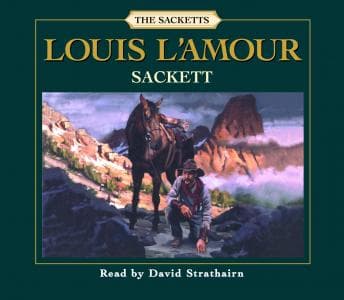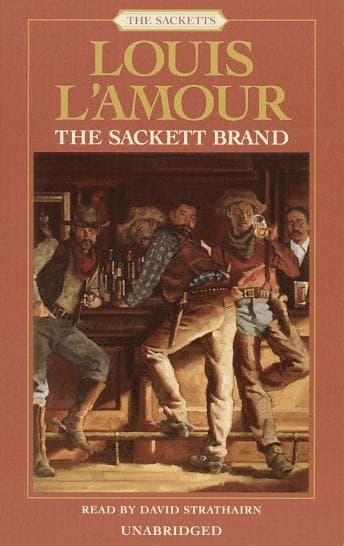

I was up way too late reorganizing my board game shelf — yes, again, and yes, the Gloomhaven box still doesn't fit anywhere reasonable — when I needed something to keep me company that wasn't going to demand too much brainpower. I'd been on a Sanderson kick for weeks, so I figured a hard left turn into Louis L'Amour territory might be exactly the palate cleanser I needed. Four hours later, my shelf was still a mess, but Tell Sackett had wormed his way into my head.
Let me be upfront: this is not my usual genre. I'm a magic systems and progression fantasy guy. My D&D group would roast me for voluntarily picking up a Western. But here's the thing — strip away the setting, and The Sackett Brand is basically a survival dungeon crawl. Legend of Corinair scratches that same stripped-down survival instinct if you want something that keeps the genre trappings I'm more comfortable defending to my committee. One guy, no gear, no allies, hunted across Black Mesa by enemies he can't even identify yet. That's a zero-to-hero arc. That's LitRPG without the stat blocks. I was more into this than I expected.
A Wounded Man on a Cliff Is Just a Level 1 Character With No Inventory
The setup is brutally efficient. Tell Sackett gets shot, falls off a cliff — like a cliff cliff, not a gentle slope — and crawls back to find his wife Ange gone. No weapons, no food, no friends, hunted by a small army of men who want him dead for reasons he doesn't understand. L'Amour doesn't waste a single page. At four hours and change, this book moves like a rattlesnake strike compared to the 40-hour fantasy epics I usually mainline.
And that's where the comparison gets interesting. Where Sanderson would spend three chapters establishing the rules of the world's geology and then pay it off 800 pages later, L'Amour just... drops you in. The Arizona landscape IS the magic system here. Tell's survival depends on knowing which canyon offers cover, where water collects after rain, how to move through rough country without leaving tracks. It's not Sanderson-level world-building in the traditional sense, but the specificity of the terrain knowledge scratches a similar itch. L'Amour clearly knew this land the way Tolkien knew his languages.
The mystery of who's hunting Tell and why they took Ange kept me going through the middle stretch. It's not a complex whodunit — this is pulp adventure, not a detective novel — but the slow reveal works. And when the truth drops, there's a satisfying click, like a puzzle piece you didn't know was missing.
David Strathairn Plays It Like a Poker Hand, Cards Close to the Chest
Here's where I have to be honest. David Strathairn's narration is... a choice. And whether it works for you depends entirely on what you want from a Western audiobook.
His Tell Sackett is restrained. Really restrained. The guy's been shot, lost his wife, is starving and freezing, and Strathairn reads it like a man recounting the events three years later over black coffee. There's a frontiersman authenticity to it — Tell isn't the type to weep or rage, he's the type to set his broken bones and keep moving. Strathairn gets that. His voice has this weathered, low-key quality that sounds like it belongs on a ranch porch at dusk.
But — and this is a real but — if you're coming from narrators like Steven Pacey, who can make you feel Logen Ninefingers' self-loathing in a single exhaled word, Strathairn is going to feel flat. He doesn't differentiate characters much. Bad guys, allies, Tell himself — they all live in the same narrow vocal register. During the action sequences where Tell is literally fighting for his life, I wanted more umpf, more adrenaline in the delivery. Instead, Strathairn keeps the temperature even. It's controlled. Some people will call that professional restraint. I found myself wishing he'd let the leash slip just a little, especially in that final stretch where the other Sacketts show up and everything goes loud.
Steven Pacey walked so other narrators could run, and Strathairn is... walking at a very dignified pace.
Who Rides and Who Stays in Town
If you're already a L'Amour fan or a Sackett series devotee, this is an easy pickup. Four hours, tight story, solid narrator who respects the material. If you want something for a short road trip or a weekend chore session, the length is perfect and it doesn't demand you remember seventeen character names.
If you need bombastic narration with distinct character voices and big emotional swings? This isn't your horse. And if you need magic systems and stat blocks — look, I'm not going to pretend L'Amour is scratching that itch directly. But the survival progression? The "man with nothing slowly becoming dangerous again" arc? My D&D group would love this as inspiration for a low-fantasy one-shot.
I read this instead of writing my thesis. Dr. Patel would not approve. But Tell Sackett didn't ask for anyone's approval either, and that worked out fine for him.
Roll for Survival, Modifier: Grit
The Sackett Brand is lean, mean frontier fiction that does exactly what it promises in four tight hours. Strathairn's narration fits the stoic cowboy energy even if it leaves some emotion on the table. It's not going to convert you if you've never cared about Westerns, but it might — like it did for me — remind you that a good survival story transcends genre. Sometimes you don't need a hard magic system. Sometimes you just need a man, a mountain, and a reason to keep climbing.