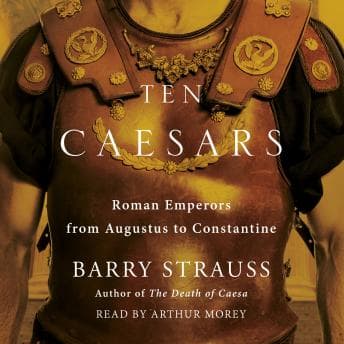

I expected this to feel like homework. Roman emperors? Ten of them? That's the kind of thing I assign to juniors who need extra credit, not something I voluntarily listen to while walking the lakefront at 6 AM. But here's the thing: Barry Strauss writes ancient history the way a good novelist writes character studies. And Arthur Morey narrates it like he actually cares whether you're paying attention.
I went in thinking this would be dry. Dates, battles, succession crises - the stuff that makes my students' eyes glaze over faster than you can say "Pax Romana." What I got instead was something closer to a family saga. A dysfunctional, murderous, occasionally incestuous family saga spanning four centuries. (Don't tell my department chair I described it that way. Actually, she'd probably appreciate it.)
Arthur Morey Gets the Assignment
Morey is the kind of narrator who understands that history isn't just information - it's story. He doesn't perform the emperors as distinct characters exactly, but he shifts his delivery in subtle ways that signal when we're dealing with Augustus's calculated restraint versus Nero's theatrical excess. There's a clarity to his reading that never feels clinical. He sounds like a professor you'd actually want to have coffee with - someone who's genuinely fascinated by this material and wants you to be fascinated too.
What struck me most was his pacing. Strauss's prose has a rhythm to it, and Morey respects that rhythm. He pauses where the author intended pauses. He lets the dramatic moments breathe. When Constantine's story shifts the entire trajectory of Western civilization, you feel the weight of it. That's not easy to pull off with nonfiction narration.
Ten Portraits, One Empire
Strauss makes an interesting structural choice here - he's not giving you a comprehensive history of Rome. He's giving you ten portraits that, together, tell a larger story about how empires adapt or die. Augustus builds the machine. Tiberius inherits it awkwardly. Nero nearly destroys it. Vespasian rebuilds. And so on.
This reminded me of what Plutarch was doing with his parallel lives - using individual biography as a lens for understanding broader historical forces. That same biographical approach to understanding power shows up in Art of War, though Sun Tzu's focus is more tactical than personal. Strauss isn't quite at that level (who is?), but he's clearly learned from the classics. Each emperor becomes a case study in power: how to get it, how to keep it, how to lose it spectacularly.
The Wall Street Journal apparently compared this to Game of Thrones, and I get it - there's poison, there's betrayal, there are family members plotting against each other. But that comparison sells the book a bit short. This is real history, and Strauss treats it with the seriousness it deserves while still making it accessible. My students would probably prefer the HBO version, but some of them might actually finish this audiobook. That's saying something.
The Bias Question (Because Someone Always Asks)
I did notice - and some other listeners have too - that Strauss has opinions. Strong ones. His treatment of Constantine in particular feels a bit loaded. If you're looking for purely objective, "just the facts" history, this isn't it. But honestly? I don't think that kind of history exists, and I'm not sure I'd want to listen to it if it did.
Strauss is upfront about his interpretations. He's making arguments, not just reciting events. As someone who spends his days teaching teenagers to read critically, I appreciate that. It gives you something to push back against. It makes the history feel alive rather than settled.
Who This Is (and Isn't) For
If you loved Robert Graves's I, Claudius, this is its nonfiction cousin. Less novelistic drama, more historical grounding, but the same sense that these were real people making real decisions with consequences that echoed for centuries. Zookeeper's Wife captures that same quality of real people navigating impossible historical circumstances, though in a much more recent and intimate setting.
Skip this if you want comprehensive Roman history or purely neutral scholarship - Strauss has a point of view and he's not hiding it. But if you want ten vivid portraits that make ancient power struggles feel uncomfortably relevant? This delivers.
At nearly thirteen hours, it's a commitment. But it never felt like a slog. I finished it over about two weeks of morning walks and late-night grading sessions, and I found myself actually looking forward to picking it back up. The chapters on Hadrian and Marcus Aurelius were particular highlights - Strauss captures something essential about each man's approach to the impossible job of running an empire. I listened at 1.0x because Strauss chose those words carefully, and Morey delivers them with the respect they deserve.
Class Dismissed
This is why we still read the classics. Or in this case, listen to them. The Roman Empire isn't just ancient history - it's a mirror. Strauss holds it up, Morey makes sure we're paying attention, and what we see looking back is uncomfortably relevant. Power, succession, the tension between tradition and reform - these aren't solved problems.
My students would probably hate this. I loved it.




![Steve Jobs [unabridged audiobook] audiobook cover](/_next/image?url=https%3A%2F%2Fcovers.audiobooks.com%2Fimages%2Fcovers%2Ffull%2F9788499923406.jpg&w=1920&q=75)