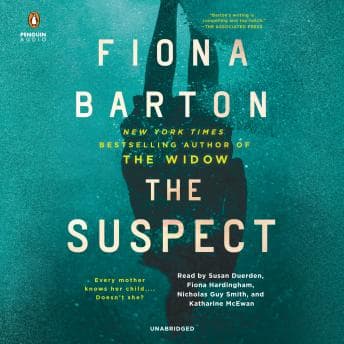

Look, if you're going to write a thriller about two girls disappearing in Thailand and expect me to stay locked in for eleven-plus hours, you better not let me figure out who did it by hour three. And that's exactly where Fiona Barton's Suspect lost me.
But let me back up. I was pressure-washing the back deck - Linda's been on me about it for weeks - and figured this would be a solid companion for mindless labor. Missing persons case, international setting, journalist protagonist with personal stakes. The setup had potential. Barton's a former Fleet Street reporter, and you can feel that in how she constructs Kate Waters. The woman moves through a story the way real journalists do - part bloodhound, part diplomat, always calculating the angle. That part rang true.
When the Mother's Voice Broke Through the Spray
Here's what kept me from bailing entirely: Fiona Hardingham narrating the mother, Lesley. This woman delivers something genuinely painful - a fragile, exhausted misery that occasionally cracks open into this fierce, almost feral anger. You know that sound a parent makes when they're past crying and into something darker? Hardingham nails it. There's a stretch in the Thai hotel scenes where Lesley is just... disintegrating. And Hardingham doesn't oversell it. She lets the silence do work. That's craft.
Susan Duerden handles Kate Waters with a BBC-polished tone and does solid work differentiating the Thai and Dutch characters she encounters - the accent shifts are subtle enough to not feel like a party trick. But here's the thing: if you came from Barton's earlier books with Mandy Williams voicing Kate, Duerden's version feels more worn down. Whether that's intentional character evolution or just a different performer's energy, it created a flatness that dragged through the middle sections.
Nicholas Guy Smith and Katharine Lee McEwan round out the ensemble. Four narrators for a story this size is ambitious, and the production is clean - no jarring transitions, no audio artifacts. The ensemble approach means you always know whose head you're in, which matters because Barton jumps perspectives constantly.
The Predictability Problem
And that jumping is where the mission goes sideways. Barton's structure has her hopping between timelines and characters - Kate in the UK, the families, the investigation in Thailand, and Kate's missing son Jake threading through everything. I've briefed intelligence reports with fewer moving parts. The problem isn't complexity. I can handle complexity. The problem is that none of these threads build enough tension independently before she cuts away.
Worst of all? The identity of the killer. I won't spoil it, but I had my suspect locked in well before the halfway mark. And I don't say that to brag - I'm not some armchair detective genius. The breadcrumbs were just too obvious, laid out in a straight line rather than scattered. A good thriller should make you doubt your own theory at least twice. This one never made me flinch. Whispers in the Dark managed to keep me second-guessing my read on the culprit clear through to the final hour, which is exactly the standard I'm holding everyone else to.
There are also subplots that Barton opens up and then... just leaves hanging. Like she started building a forward operating base and then got redeployed before finishing. It's frustrating, especially at this length. Eleven and a half hours is a real commitment, and when threads don't pay off, you feel cheated.
What Barton Gets Right (Because It's Not All Bad)
The journalism angle is authentic. Barton spent years in the British press, and you can tell. Kate's internal calculations about when to push a source, when to back off, how to frame a story for maximum impact - that stuff has the texture of lived experience. I got a similar feeling from Games - that same sense that the writer had actually been in the room with these people before putting them on the page. I've worked with enough embedded reporters to recognize the type. She also captures something real about how families perform grief in public while privately falling apart. That duality between Lesley's media appearances and her hotel room breakdowns felt honest.
And the Thailand setting works. Not in an exotic-vacation-gone-wrong cliché way, but in the specific disorientation of navigating a foreign bureaucracy while your world is ending. The helplessness of being far from home with no control.
Who Should Saddle Up - And Who Should Stand Down
If you're deep into Barton's Kate Waters series, you'll want this for continuity. If you like multi-narrator productions and domestic suspense with a journalism angle, it'll scratch that itch. But if predictable reveals make you crazy, or if loose ends keep you up at night (the bad kind of up at night), temper your expectations.
Ranger fell asleep during the middle third, and honestly, his instincts weren't wrong. The bookends are stronger than the center. Worth your time? Here's the debrief: it's a competent thriller elevated by one standout vocal performance and hamstrung by a plot that shows its hand too early. Not a failure, but not a mission I'd volunteer for twice.