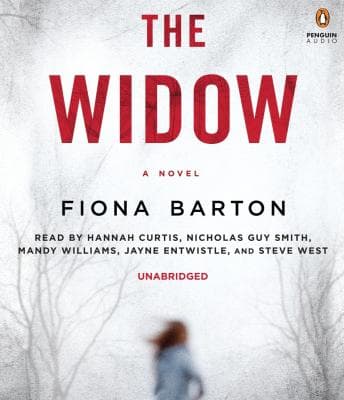

Jean Taylor is lying to you. She's been lying for years. And the brilliance of Fiona Barton's The Widow is that you know this from the first chapter—and you still can't figure out what the truth actually is.
I binged this during a rainy weekend, which honestly? Perfect atmosphere. The kind of grey, oppressive weather that matches a book about a woman who's spent years standing beside a husband accused of abducting a child. Now he's dead. Now she can talk. But Jean has learned something dangerous: she can make people believe anything.
This is horror disguised as a thriller. Not the supernatural kind—the kind that lives in marriages, in silences, in the stories we tell ourselves to survive.
Five Voices, One Fractured Truth
The multi-narrator approach here is smart. Really smart. You get The Widow (Hannah Curtis), The Mother (Jayne Entwistle), The Detective (Nicholas Guy Smith), The Husband (Steve West), and The Reporter (Mandy Williams). Each perspective chips away at what you think you know.
Hannah Curtis as Jean is going to be divisive. I've seen reviews calling her flat, mousy, unconvincing. And look—I get it. Jean doesn't emote the way thriller protagonists usually do. She's controlled. Measured. Almost eerily calm. But here's the thing: that's the point. Jean has spent years performing the role of devoted wife while journalists camped outside her door and neighbors spat at her in the street. Of course she sounds detached. She's dissociated from her own life.
Curtis commits to that interpretation, and it works. The moments when Jean's mask slips—when you hear the slightest tremor, the smallest crack—those hit harder because of the restraint everywhere else. Is it a bold choice? Yes. Will everyone love it? No. But I'd rather a narrator make a specific choice than play it safe.
Steve West as The Husband is appropriately unsettling without going full villain. You understand how Jean could have loved him. You also understand how she might have feared him. That ambiguity is crucial.
The Slow Burn That Paid Off
Fair warning: this is not a fast-paced thriller. If you need constant action and plot twists every chapter, you might find yourself checking how much time is left. I won't pretend there weren't moments in the middle where I zoned out slightly—some of the detective procedural sections drag, and there's a lot of ground-laying that feels methodical rather than urgent.
But Barton's background as a journalist shows. She's not interested in cheap thrills. She's interested in how ordinary people become complicit in extraordinary evil. How a wife can know and not-know something simultaneously. End Game explores similar territory—that psychological space where complicity and denial blur together. How grief and guilt and love get tangled up until you can't tell them apart.
The pacing is deliberate because the reveal isn't just "what happened"—it's "who is Jean Taylor, really?" And that takes time to build.
When the Mask Finally Cracks
I can't say much without spoilers, but the final act delivers. The pieces click into place in a way that made me immediately want to relisten to certain sections. (I didn't. But I wanted to.) Barton plays fair with the clues—they're all there if you're paying attention. I wasn't paying close enough attention. My own fault.
One minor issue: Mandy Williams and Jayne Entwistle sound similar enough that I occasionally got confused about whose perspective I was in. Not a dealbreaker, but worth noting if you're listening while multitasking.
The Horror of the Ordinary
This understands that horror isn't about gore—it's about dread. The dread of a marriage with secrets. The dread of a mother who will never stop searching. The dread of knowing something terrible and choosing silence.
Shirley (my cat) was unimpressed. She fell asleep on my chest during the tensest section. But I was gripped. The kind of gripped where you forget to eat lunch because you need to know what Jean is hiding.
Content note: this deals with child abduction. It's handled with restraint—no gratuitous details—but the emotional weight is heavy. The mother's sections are genuinely painful to listen to.
Who This Is (and Isn't) For
If you loved Gone Girl but wanted something less flashy and more psychologically claustrophobic, this is your book. If you appreciate audiobooks that use multiple narrators to create genuine uncertainty rather than just variety, this is your book. If you want a thriller that trusts you to sit with discomfort rather than rushing to reassure you, this is your book.
Skip it if you need constant momentum or find slow-burn pacing frustrating. The payoff is worth it, but you have to be willing to wait for it.
Adding This to the Podcast Queue
My listeners are going to have opinions about Hannah Curtis's performance, and honestly? I'm here for that debate.